


Golden retrievers look like the easiest yes in the dog world. Friendly face, always smiling, great with kids.
The breed’s popularity comes from a filtered version of ownership, one that skips the parts that decide whether you’ll actually thrive with one.
Here are the 10 things to know before getting a golden retriever: the real costs, the health risks breeders rarely lead with, and what daily life looks like once the puppy energy wears off.
This guide does not cover training techniques or nutrition plans. I’ve already written both on my website.
You can read them there: training techniques and nutrition plans.
1. Golden retrievers carry a 60% lifetime cancer risk
This number changes the whole decision, so it goes first.
The Morris Animal Foundation’s Golden Retriever Lifetime Study has tracked nearly 3,000 dogs since 2012.
It found that about 60% of golden retrievers will be diagnosed with cancer at some point in their lives, one of the highest rates recorded in any breed.
The main culprits are hemangiosarcoma, lymphoma, osteosarcoma, and mast cell tumors.
Health, not behavior, is the highest long-term cost and heartbreak driver for this breed.
Chewing and leash-pulling are trainable. Cancer risk and joint disease are not.
One caveat worth making: you’ll see a “60% cancer rate” figure and a separate “50% will die of cancer” figure used almost interchangeably online.
They’re not the same claim. One is diagnosis risk. The other is cause of death.
The Morris study tracks diagnosis; older breed-mortality surveys track cause of death.
Either way, the number is high enough to shape everything else on this list.
Some breed-club pages argue that a well-bred golden, from health-tested lines going back generations, carries meaningfully lower risk than the breed average.
That’s a fair point for dogs with documented OFA and cardiac clearances on both parents.
But if you’re buying from a backyard breeder or an unverified online listing, that reassurance doesn’t apply, and the risk sits closer to the 60% figure above.
Point 8 covers exactly what documentation to check before you trust that reassurance.
2. First-year costs run $3,000 to $6,000
A golden retriever puppy from a reputable, health-tested breeder typically runs $1,000 to $3,500 as of 2026.
Rescue adoption is cheaper, usually $200 to $850. That’s just the purchase price.
According to the ASPCA’s pet care cost breakdown, ongoing annual care for a large dog runs roughly $1,391 or more.
Add vaccines, spay or neuter, a crate, food, basic training, and supplies, and a realistic first-year total lands between $3,000 and $6,000.

3. Lifetime cost averages $23,000
Lemonade’s breed cost data puts the average lifetime cost of owning a golden retriever at around $23,000. That’s more than Labradors, less than Akitas, still a five-figure commitment.
This number connects directly to point 1. Golden retrievers carry a well-documented, elevated cancer risk. If it happens, the bill is real.
Chemotherapy alone typically runs $3,000 to $10,000, according to Embrace Pet Insurance.
Full treatment, including diagnostics, oncologist consults, surgery, and radiation, commonly totals $10,000 to $20,000, according to Cornell University’s veterinary oncology program.
4. Insure before symptoms appear, not after

Trupanion and Embrace both cover hereditary and cancer-related conditions as part of their standard policies, not as paid add-ons.
Trupanion requires no pre-existing signs or symptoms before your enrollment date.
Embrace excludes hip dysplasia coverage for the first 12 months of a policy. In practice, the earlier you enroll, before any symptom shows up, the more of the breed’s cancer and joint-disease risk actually gets covered.
Wait until your dog is already limping or has a lump, and that condition can get excluded as pre-existing.
That’s the single most avoidable financial mistake on this whole list.
5. They need 60 to 90 minutes of exercise daily

A golden retriever isn’t a low-maintenance couch companion. It’s a sporting breed built to work all day, and it acts like one.
Expect 60 to 90 minutes of real exercise daily: running, fetch, swimming, or structured play, not a slow walk around the block.
Skip it for a few days, and you’ll likely see destructive chewing, excessive barking, or a dog that seems to climb the walls.
6. Shedding means brushing 3 to 4 times a week
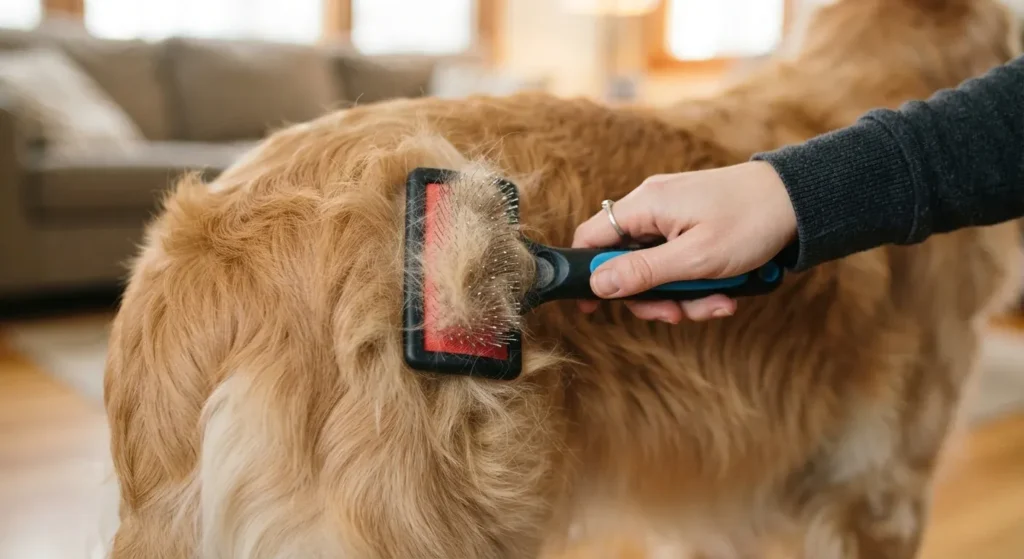
Goldens blow their coat twice a year and shed moderately every day in between. In practice, that means brushing 3 to 4 times a week minimum, and daily during spring and fall shedding season.
Owners who skip this end up with mats, hot spots, and a house that looks vacuumed five minutes ago and covered in fur ten minutes later.
Pro Tip: the shedding volume surprises almost everyone who’s only met a golden at the dog park for twenty minutes.
7. They’re “velcro dogs” prone to separation anxiety

There’s a separation anxiety angle most articles skip. Goldens bond hard and don’t do well alone for long stretches, which is why the breed earned the nickname “velcro dog.”
That’s a real problem for anyone planning a return-to-office move.
A dog raised through remote-work years with constant company can develop genuine anxiety when the house suddenly empties for eight hours.
8. Ask for OFA hip, elbow, and heart clearances

Reputable breeders health-test for hip dysplasia, elbow dysplasia, heart conditions, and eye disorders, conditions that show up disproportionately in this breed.
Before you pay a deposit, ask for:
- OFA hip and elbow clearances on both parents
- A cardiac exam from the sire and dam
- An eye clearance (CERF or OFA Eye) dated within 12 months
- Proof of first vaccinations and deworming
A breeder who can’t produce OFA (Orthopedic Foundation for Animals) documentation on request isn’t worth buying from.
9. Reputable breeders offer lifetime support

A good breeder doesn’t disappear after the sale. Ask whether they offer a health guarantee, whether they’ll take the dog back at any point in its life if you can’t keep it, and what socialization the litter had by 8 weeks.
If you’d rather adopt, the Golden Retriever Club of America’s rescue network is a solid starting point, and rescue dogs tend to come with a documented health history already in hand.
10. They’re beginner-friendly, but not low-maintenance

Golden retrievers can work well for a first-time owner. Trainability is genuinely one of the breed’s strongest points. But “good with beginners” isn’t the same as “easy.”
Quick comparison
| Option | Best for | Key benefit | Limitation |
|---|---|---|---|
| Golden retriever | Active families, first-timers with time to invest | Highly trainable, social, kid-friendly | High cancer risk, heavy shedding, needs 60 to 90 min/day exercise |
| Labrador retriever | Similar activity level, slightly lower grooming needs | Comparable temperament, shorter coat | Prone to obesity and joint issues |
| Standard poodle | Owners with allergies or low tolerance for shedding | Low-shed, hypoallergenic-leaning coat, very trainable | Needs regular professional grooming, higher upkeep cost |
Golden Retriever vs Labrador Retriever: goldens suit owners who want a longer, showier coat and don’t mind extra brushing.
Temperament is nearly identical between the two breeds. Labradors work better when shedding tolerance is lower.
FAQs
Is a golden retriever a good dog for a first-time owner?
Yes, generally. They’re trainable and social, but only for owners ready for daily exercise and real vet-cost planning.
How much does a golden retriever cost in the first year?
Typically $3,000 to $6,000, including purchase price, vaccines, spay or neuter, supplies, and basic training.
Why do golden retrievers get cancer so often?
Researchers point to a narrow historical gene pool and inherited genetic predisposition, tracked closely by the Morris Animal Foundation’s ongoing lifetime study.
Should I get pet insurance for a golden retriever puppy?
Yes. Enroll as early as possible, before any symptoms appear, since conditions already showing signs can be excluded as pre-existing.
How much exercise does a golden retriever need daily?
Plan on 60 to 90 minutes of real physical activity every day, not just a short leash walk.
Conclusion
Golden retrievers earn their reputation. They also come with a bill, financial and emotional, that most puppy photos don’t show.
Before you contact a breeder or rescue, run through this: can you commit 60 to 90 minutes of daily exercise, a monthly grooming routine, and a savings buffer or insurance policy set up before any symptoms appear?
If the honest answer is yes, a golden retriever is a genuinely good fit.
Download our free pre-purchase checklist: a one-page rundown of the questions to ask a breeder, the OFA paperwork to request, and a first-year cost worksheet you can fill in with your own numbers.