

Preparing your home for a Golden Retriever puppy involves puppy-proofing low-level areas, acquiring a basic list of essentials, and setting up a crate and a potty routine before the day you pick him up.
Golden Retriever puppies chew, play fetch, and grow rapidly; keep in mind that as an adult, the dog will weigh between 25 and 34 kg (55 to 75 pounds).
If you are bringing the puppy home this weekend, do these three things first:
- Install a safety gate on the stairs
- Set up the crate
- Put all trash cans behind a closed door.
Everything else can wait a few days.
You’ve already reserved the puppy and are counting down the days; it’s easy to give in to the temptation to overbuy.
This checklist follows a timeline, from two weeks prior to the first week at home, and highlights the essentials.
Golden Retrievers rank third among dog breeds in the U.S. according to 2025 AKC registration statistics.
The most recent APPA survey estimates there are 94 million pet-owning households in the U.S., with about 68 million owning dogs (according to a Petfood Industry report).
This guide focuses on bringing a healthy, eight-week-old Golden Retriever puppy into a U.S. home.
It does not cover adopting adult dogs, rescue puppies with medical needs, or breeder-specific vaccination schedules.
It is most useful when you are one to four weeks away from picking up your puppy. This is general information, not veterinary advice; your veterinarian’s instructions take precedence.
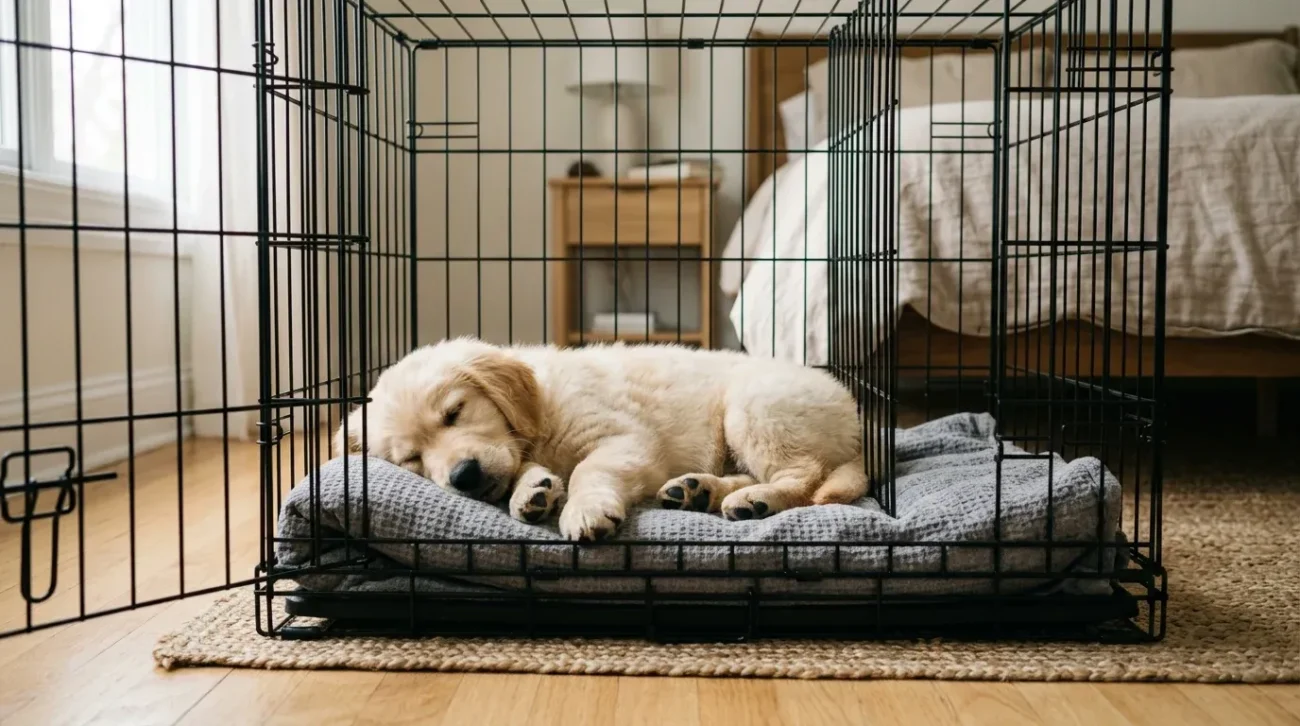
[IMAGE: golden retriever puppy resting in a 42-inch crate with the divider panel in place, bedroom setting]
What Do You Need To Buy Before A Golden Retriever Puppy Comes Home?
What a Golden Retriever puppy needs before coming home boils down to a short list:
- A 42-inch crate with a divider panel
- Food and bowls
- A collar and leash
- Chew toys
- An enzymatic cleaner
- Safety gates
- A scheduled vet appointment
According to the AKC breed standard, adult males weigh between 65 and 75 pounds (approx. 29–34 kg) and females between 55 and 65 pounds (approx. 25–29 kg); therefore, buy accessories suitable for a large breed dog.
The bottom line is this: you need about 10 items for the first week. Young puppies sleep most of the day, often 18 to 20 hours, so the key accessories are a place to rest, something to chew on, and a quick way to get outside.
Here is what to buy now and what to expect.
Buy These Essential Supplies Before Pickup Day
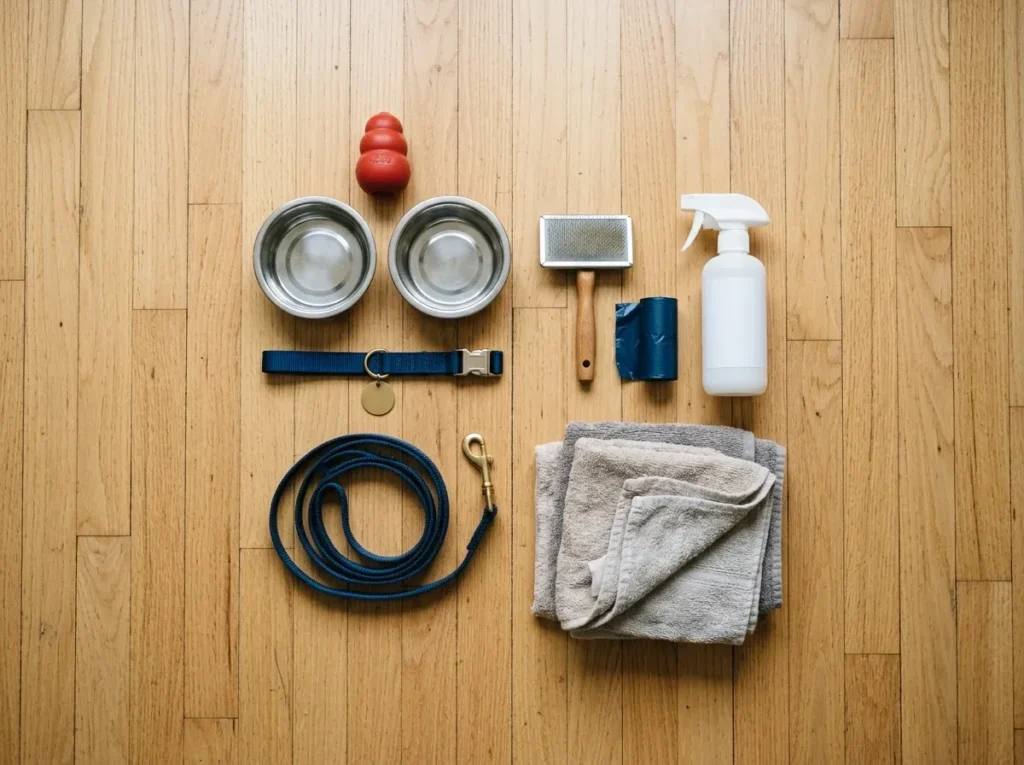
- Crate: A 42-inch MIDWEST iCrate double-door folding crate with an included divider panel. It is suitable for an adult Golden, and the divider allows you to reduce the space for the puppy. Prices usually range from $60 to $110; check for current deals.
- Chew toys: A KONG Puppy toy (made of softer rubber for baby teeth) and 3 or 4 toys with different textures. Check the size chart to ensure no toy can get stuck in the puppy’s throat. Fill the KONG with wet food, freeze it, and use it as a treat inside the crate.
- Cleaner: Nature’s Miracle stain and odor remover. Enzymatic cleaners break down urine, preventing the area from continuing to attract future accidents.
- Food and bowls: the same food the breeder uses, plus two stainless steel bowls. Consult your veterinarian to confirm the formula is suitable for large-breed puppies, and if you decide to switch brands, make the transition gradually over 7 to 10 days. The WSAVA nutrition guidelines include questions you can ask any pet food manufacturer.
- Collar, ID tag, and leash: an adjustable flat collar, an ID tag with your phone number, and a 6-foot (approx. 1.8-meter) leash.
- Safety gates: 2 or 3. Use a screw-mounted (hardware-mounted) gate at the top of any staircase.
- Cleaning and grooming supplies: paper towels, waste bags, old towels, and a slicker brush for the coat.
If You Are On A Tight Budget, Buy Items In This Order:
- Crate (or carrier) with a divider panel and baby gates
- Food and bowls
- Collar, ID tag, and leash
- Enzymatic cleaner
- A KONG puppy toy and 2 other chew toys
- Slicker brush
The crate, chew toys, cleaner, tag, leash, brush, and waste bags totaled approximately $160–$200 based on Chewy prices in October 2026.
Baby gates, the first bag of puppy food, vet visits, and training classes come at an additional cost.
Look into pet insurance before the first check-up, as many plans exclude conditions that appear before coverage begins.
Hold Off On These Items
Some purchases can wait 4 to 6 weeks:
- A full-sized bed. In my opinion, though some owners might disagree, it is better to buy this when the dog is about 4 months old and use folded old towels until then, since replacing them costs nothing.
- A harness. A Golden Retriever puppy’s chest size changes rapidly, and some trainers prefer using a collar and leash for initial lessons. Consult your trainer.
- Retractable leashes, rawhide, and very hard chew items like antlers. Ask your veterinarian which products are safe, and save any items you are unsure about for supervised play.
- A large number of toys. Leave out only 4 or 5 toys and rotate them weekly.
Book 2 Appointments Before Picking Up The Puppy
Schedule a vet appointment before picking the puppy up.
Many breeder contracts require a veterinary check-up within a few days of pickup, and clinics may be fully booked for a week or more.
During that visit, ask about flea, tick, and heartworm prevention.
Also, ask about the right time for spaying or neutering.
A 2013 UC Davis study involving 759 Golden Retrievers linked early neutering to an increased number of joint problems, so the timing of the procedure warrants a serious conversation with your veterinarian (PLOS ONE study).
A Golden Retriever puppy should begin socializing as early as 7 or 8 weeks of age, even before completing their vaccination series.
According to the American Veterinary Society of Animal Behavior (AVSAB), the first three months are the most critical period for socialization.
The AVSAB reports that behavioral issues are the leading cause of death in dogs under 3 years of age (AVSAB position statement, AVMA news summary).
Look for a class that verifies vaccination records and keeps group sizes small. Ask which vaccinations the class requires.
Until your veterinarian gives the all-clear, avoid dog parks and walking on the floors of pet stores.
How Do You Puppy-Proof A House For A Golden Retriever?
To puppy-proof your home for a Golden Retriever, start at floor level: remove anything the puppy could reach, chew, or swallow.
According to the ASPCA, foods such as chocolate, coffee, alcohol, and yeast dough are dangerous to pets.
Add grapes, raisins, onions, macadamia nuts, and xylitol to that list, and keep them securely locked away (ASPCA list of human foods).
Get down on all fours and inspect each room from the puppy’s perspective.
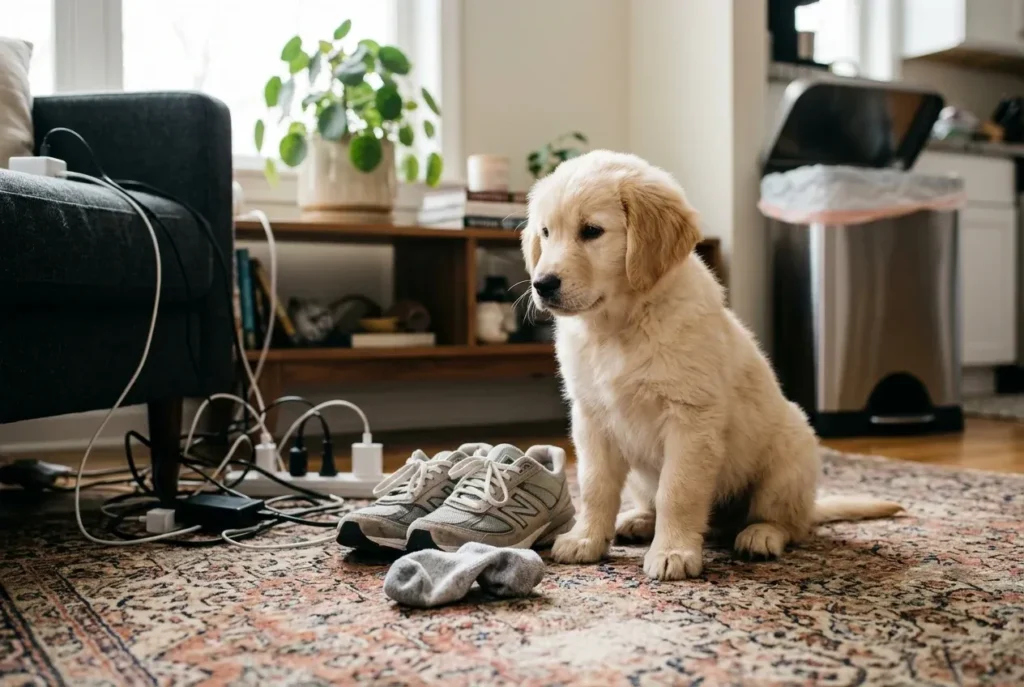
Spending about 10 minutes per room will help you spot electrical cords, loose socks, dangling blind cords, and open trash cans.
Golden Retrievers were bred to retrieve game, so carrying things in their mouths comes naturally to them.
The items they tend to grab first are shoes, socks, children’s toys, and remote controls.
Keep closet doors closed and provide each child with a lidded storage bin.
Quick reference: common hazards
| Hazard | Where it is found | What to do |
|---|---|---|
| Xylitol | Sugar-free gum, mints, some peanut butters, toothpaste | Read labels; store in closed cabinets or on high hooks |
| Chocolate, grapes, raisins | Pantry, trail mix, kids’ bags | Latch cabinets; teach children to zip bags |
| Onions, garlic, macadamia nuts | Counters, food scraps | Use a lidded bin; skip table scraps |
| Sago palm and other toxic plants | Living room, patio pots | Move or remove; check each plant on the ASPCA plant list |
| Human medication | Nightstands, purses | Keep in closed drawers; ibuprofen is toxic to dogs |
| Electrical cords | Behind TVs, under desks | Use cord covers; unplug when unattended |
| Cleaning products, antifreeze, rodent bait | Garage, under sinks | Add child latches; avoid rodent bait entirely |
| Open doors, windows, balconies | Entry, patio, upper floors | Keep exterior doors closed; check screens; gate balconies |
Save the ASPCA Animal Poison Control Center number (888) 426-4435, in your phone before picking up the puppy.
A consultation fee may apply. If your puppy ingests anything on this list, call your veterinarian or the center immediately rather than waiting for symptoms to appear.
A puppy can slip out through a door or a gap in the fence in a matter of seconds.
Walk the perimeter of the fence to check for gaps, look for standing water, and set up a shaded area, as Golden Retrievers can suffer from heatstroke in warm weather.
[IMAGE: living room with floor-level hazards labeled: cords, shoes, houseplant, open trash bin]
What Should The Timeline Look Like From 2 Weeks Out To The First Week Home?
Five phases simplify the to-do list for pickup day.
To prepare your home for a Golden Retriever puppy, follow these steps:
- Remove toxic plants, electrical cords, and small objects from the floor.
- Set up a 107 cm (42-inch) crate with a divider in a quiet room.
- Install baby gates at the top and bottom of stairs and in doorways to rooms the puppy shouldn’t access.
- Buy food, food and water bowls, a collar, a leash, chew toys, and an enzymatic cleaner.
- Schedule a veterinary check-up for the first three days at home.
- Plan the pickup day, including a bathroom break stop and the first night.
2 Weeks Before
Call the breeder. Ask what the puppy eats, when it last ate, which vaccinations and deworming treatments it has received, and whether it is microchipped.
Ask for a blanket that retains the scent of the litter.
Map out the first two weeks on a calendar: who will be home and at what times.
A puppy left alone for four hours or more will need an exercise pen and a midday visit from someone, such as a dog walker.
Order the travel crate and safety gates now.
Agree on house rules with everyone living in your home: who will feed and walk the dog, who will handle late-night outings, what command words to use, and whether the dog will be allowed on the furniture.
1 Week Before
Crawl around the house and install safety gates. Set up the crate in your bedroom, have the food ready, and choose a spot in the garden for the puppy to relieve itself.
If possible, ask for time off work for the first two or three days.
Plan to open up one room at a time during the first week or two, so the puppy doesn’t feel overwhelmed by the entire house all at once.
The Day Before
Prepare a car kit: a leash, towels, paper towels, an enzymatic cleaner, some treats, and the blanket from the breeder.
Do a final sweep of the floors. Charge your phone, as you’ll want to take photos.
Pick-Up Day
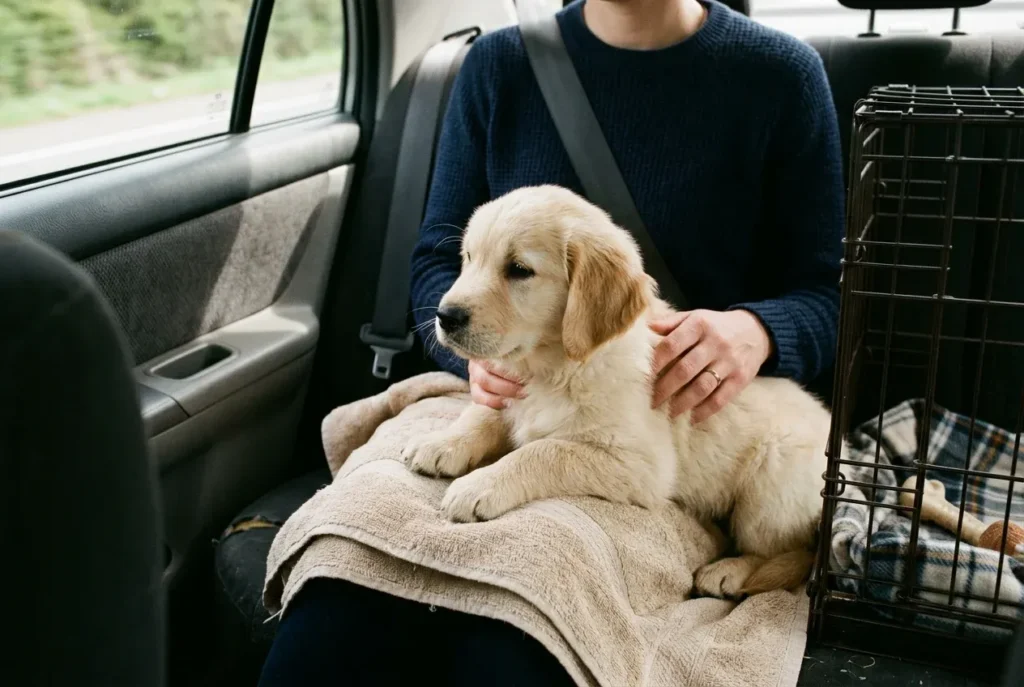
Bring another adult along. One person drives while the other holds the puppy on a towel in the back seat, or uses a securely fastened carrier.
Upon arrival, head straight to the designated garden area for bathroom breaks, wait five minutes, and praise the puppy if it succeeds.
Most veterinarians recommend three meals a day for young puppies, so stick to the breeder’s feeding schedule.
The puppy needs sleep; therefore, avoid having visitors and introduce family members one by one.
The First Night
Place the crate next to your bed. The last potty break should be around 10:30 PM; after that, the puppy goes into the crate.
A realistic schedule for an 8-week-old puppy is:
- 10:30 PM: Last potty break, then into the crate.
- Between 1:30 AM and 2:00 AM: Quiet potty break (no playing), then back into the crate.
- Around 5:00 AM: Potty break.
- 6:30 AM: Wake-up time, potty break, and breakfast.
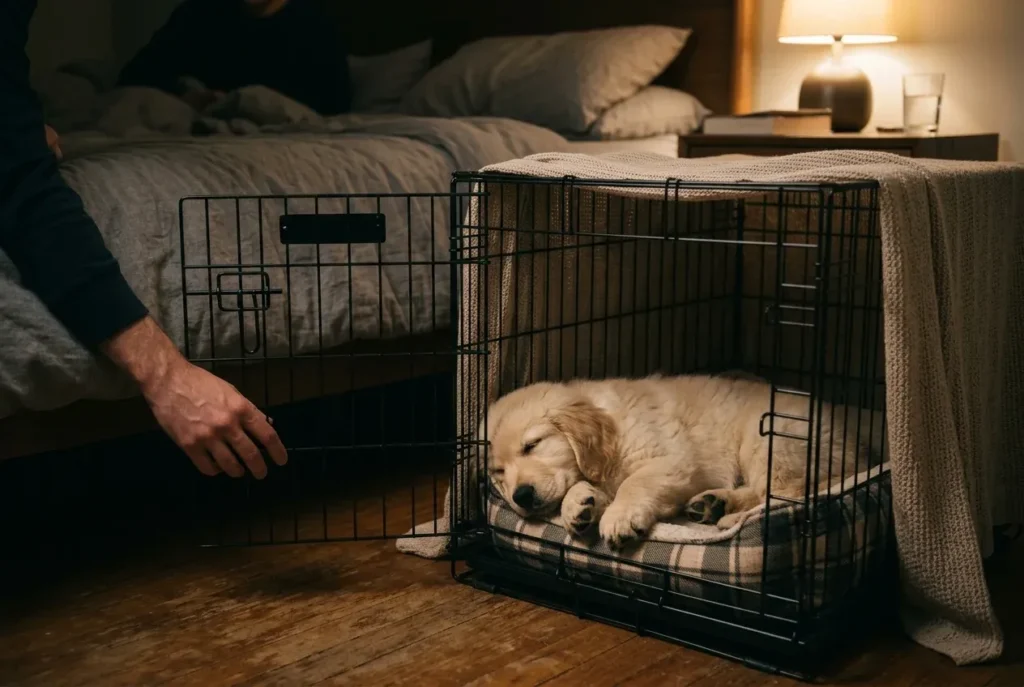
Expect some crying. Take the puppy out at the scheduled times and keep each outing boring; no talking or playing.
Avoid opening the crate in response to every whimper so that crying doesn’t become the way to get out.
Anticipate 2 or 3 nighttime outings at 8 weeks of age.
The First Week
Structure the routine around key moments:
- Taking the puppy out immediately after every nap or upon waking up
- 5 to 10 minutes after eating or drinking
- After playtime and right before going into the crate
- Three meals a day; remove any uneaten food after 10 or 15 minutes
- Five minutes of daily brushing, handling the paws, ears, and mouth while offering treats
- Exposure to the vacuum cleaner and doorbell at low volume, accompanied by treats
I have found conflicting information regarding how often a puppy should be taken out: one guide recommends every 30 minutes, others suggest every 1 or 2 hours, and one indicates every 2 to 4 hours.
My interpretation is that shorter intervals are appropriate for the first week and that these should be extended as the puppy grows.
Never scold for accidents. Clean the area with an enzymatic cleaner and move on.
Kids And Resident Pets
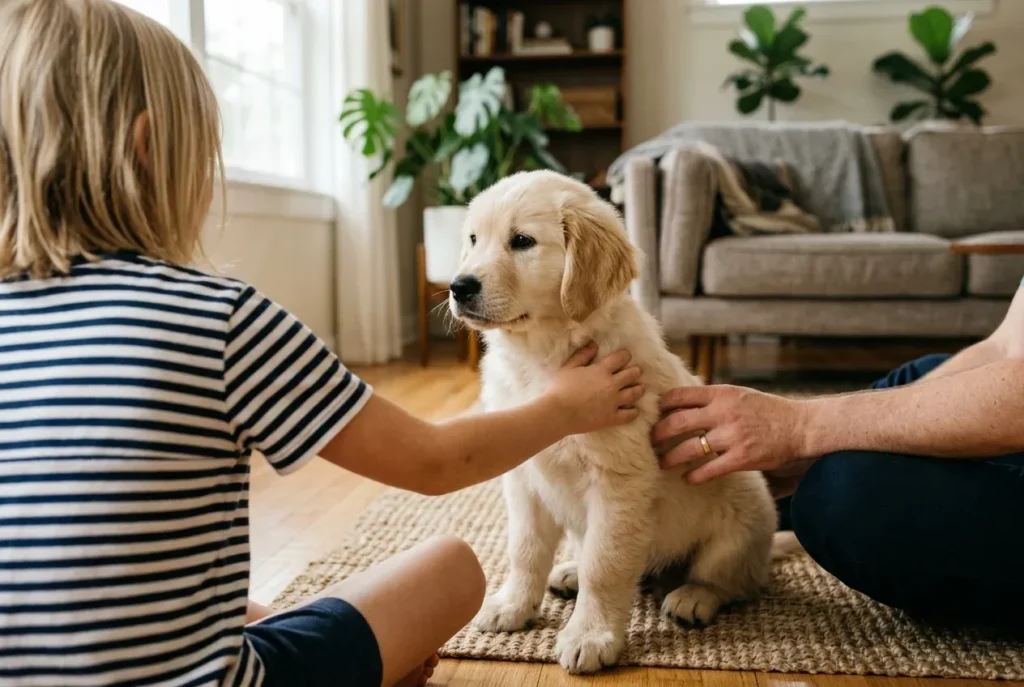
Teach children three rules: sit down to greet the puppy, pet it gently, and leave it alone while it sleeps or eats. Supervise all interactions.
Introduce the resident dog on neutral ground and on a leash, and keep the initial encounters brief.
Should You Use A Crate, A Playpen, Or A Gated Room?
Choose a primary sleeping area and prepare it before the day of pickup.
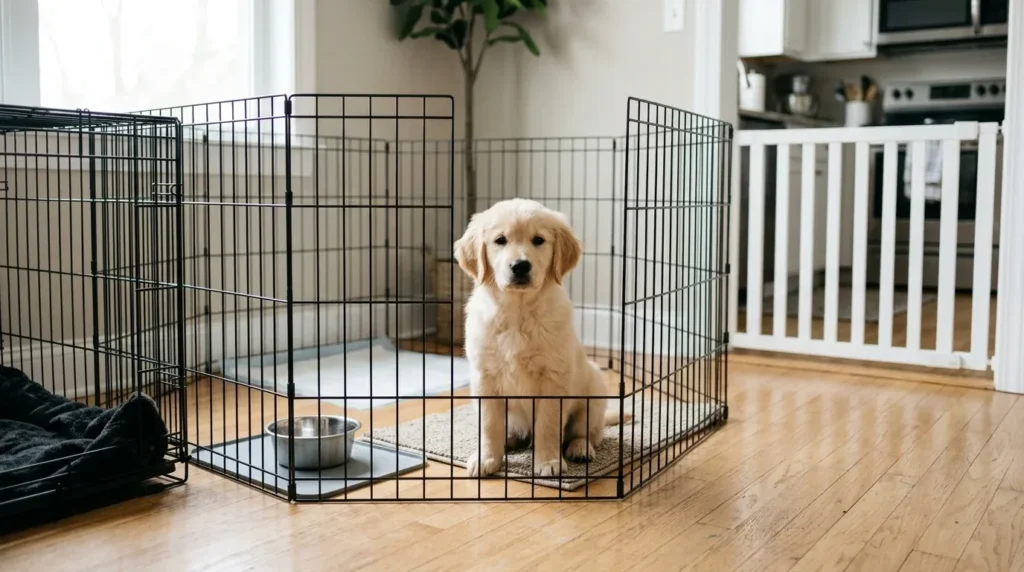
Quick comparison
| Option | Ideal for | Key Benefit | Limitation |
|---|---|---|---|
| 42-inch crate with divider | Sleep, short absences, potty training | Snug space discourages soiling | Needs resizing as the puppy grows |
| Exercise pen | Apartments, owners out 4+ hours | Separate sleep and toilet zones | Takes floor space; a growing golden may push it |
| Gated kitchen or mudroom | Short supervised periods, tile floors | Easy to clean; keeps puppy near family | Cords, cabinets, and trash still need proofing |
| Crate inside a pen | Households that want both | Sleep zone plus play and toilet zone | Uses the most space and gear |
Crate vs. Puppy Playpen: A crate is better suited for sleeping and house-training, as its compact size discourages the dog from soiling the space.
A playpen works best when no one is home for four hours or more, as it provides the puppy with separate areas for sleeping and relieving itself.
The key difference is that the crate serves a single purpose, rest, whereas the playpen accommodates resting, playing, and bathroom needs.
Some trainers prefer a playpen for the first two weeks, as the puppy can access the designated bathroom area without leaving its enclosure.
This option is ideal for households where no one is present for long periods.
A crate with a divider panel is suitable for homes where someone is around most of the day and generally requires less cleanup.
A crate that is too large can delay house-training. Trainers often note that if a puppy has extra space, it will use one end to relieve itself and sleep at the other.
Position the divider panel so the puppy can stand up, turn around, and lie down, and move it back as the animal grows.
Place the crate in a common area of the house during the day and in your bedroom at night.
Drape a light blanket over the wire crate to create a cozy, den-like atmosphere. Think of the crate as a resting place or, more accurately, as the puppy’s bedroom.
The Humane Society’s crate training guide outlines the steps for the initial introduction.
What’s Different About Preparing For A Golden Retriever?
Shedding
Golden Retrievers have a double coat. They shed year-round, with heavier shedding occurring in the spring and autumn.
This intense shedding usually begins when their adult coat comes in, a few months after birth.
Brush your dog 2 or 3 times a week from the start so that grooming becomes a routine.
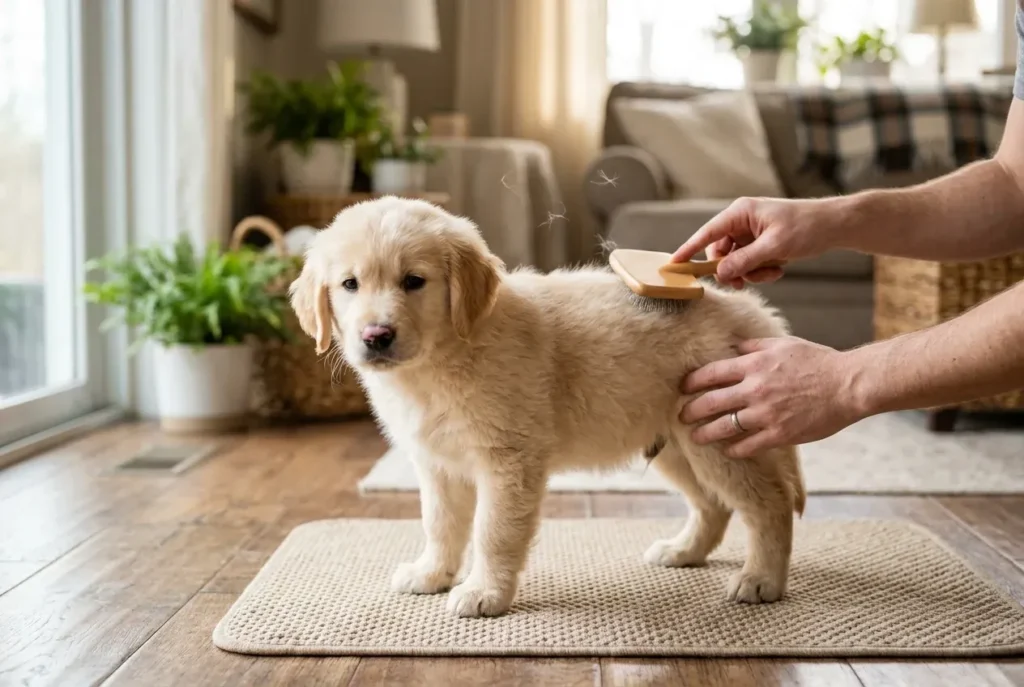
Introduce an undercoat rake once the adult coat grows in. Use washable covers on your sofas and be prepared to vacuum daily.
Tendency To Bite And Chew
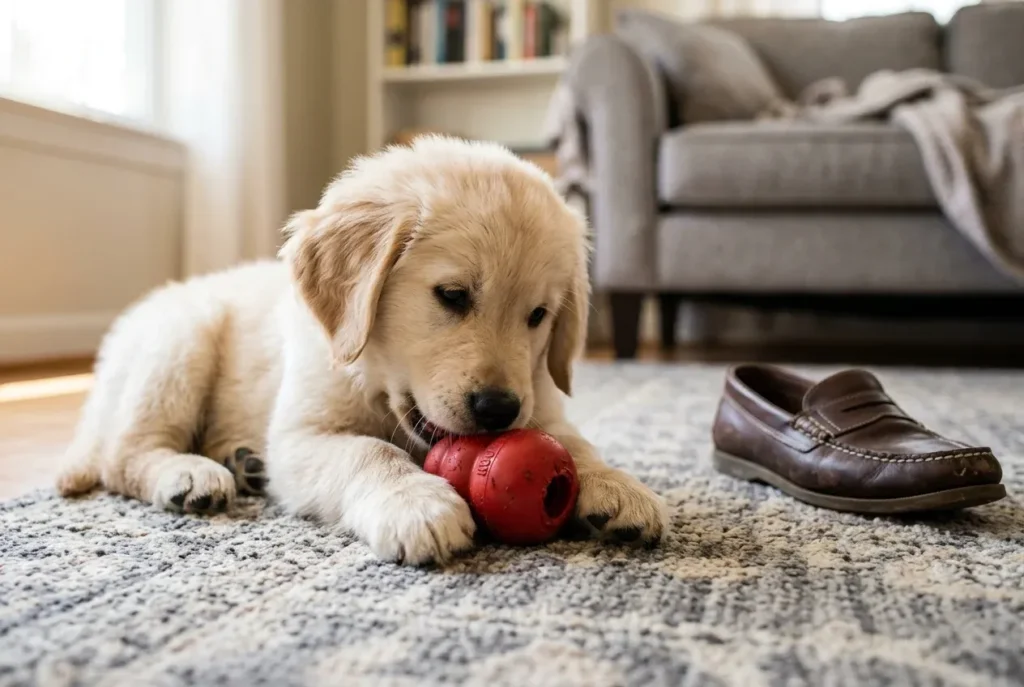
Owners often report that the habit of chewing objects peaks during the teething phase, between 3 and 6 months of age.
Rotate between 3 or 4 toys so the dog doesn’t get bored with any single one. If the puppy grabs a shoe, swap it for a treat.
Chasing the puppy teaches it that grabbing an object is the start of a game.
Rapid Growth And Joints
A Golden Retriever puppy typically weighs between 10 and 15 pounds (4.5 to 6.8 kg) at 8 weeks old and can exceed 40 pounds (18 kg) by 6 months.
This breed is prone to hip and elbow dysplasia; therefore, consult your veterinarian about safe levels of exercise, jumping, and stair-climbing for each stage of growth.
Keep play sessions short and avoid long runs on pavement. Place rugs or mats on slippery floors and install safety gates at the top and bottom of all stairs.
Include the garden in your safety check as well. Goldens love water, so fence off swimming pools, ponds, and hot tubs before the puppy can reach them.
Quick Answers About Preparing For A Golden Retriever Puppy
These are brief answers to questions new owners often ask before pickup day; each is designed to be read in under 30 seconds.
What is the best crate size for a Golden Retriever puppy?
A 42-inch crate with a divider panel. It is suitable for an adult Golden; as the puppy grows, you move the divider back to keep the space just right for standing up, turning around, and lying down.
How do I stop my Golden Retriever puppy from chewing on everything?
Remove tempting objects, offer a KONG Puppy toy (or other chew toys), and swap any items they’ve taken inappropriately for a treat. Rotate between 3 or 4 toys. The tendency to chew peaks during teething, so it is to be expected for a few months.
Where should a puppy sleep when you first bring it home?
In a crate in your bedroom, close enough that you can hear each other. Keep it beside your bed for the first few weeks, then move it in small steps. Avoid a basement or garage on night one.
Why is my Golden Retriever puppy crying in the crate?
Most puppies cry because they feel lonely for the first time or need to urinate. First, check if they need to relieve themselves, then comfort them with a blanket that holds the scent of the litter. This usually improves after a couple of weeks.
When should I start puppy training and socialization?
Start establishing house rules, potty training, and crate routines from day one. The AVSAB indicates that puppy classes can begin as early as 7 or 8 weeks of age. Check with your veterinarian first regarding vaccination requirements.
Should I crate my Golden Retriever puppy at night?
Yes, in most households. Place the crate in your bedroom for the first few weeks so you can hear when the puppy wakes up. Be prepared to take them out to relieve themselves 2 or 3 times a night when they are 8 weeks old.
Final Check Before Pickup Day
Before picking up your pet, verify five things: safety barriers installed, the carrier ready, hazardous items removed, the vet appointment scheduled, and the car kit prepared.
If anything is missing, prioritize installing the barriers and preparing the carrier.
Be prepared for accidents, a chewed-up sock, and having to get up at 2 a.m. during the first week. It’s all normal.
Keep a log of every potty break and nap during the first three days; the resulting pattern will tell you when to delay nighttime outings and when to consult the vet.
Bookmark this page and check off each phase as you complete it.
