


This guide covers healthy Golden Retrievers at standard activity levels. It does NOT address dogs with diagnosed medical conditions, food allergies, or those under active veterinary weight-management treatment — always defer to your vet for those cases.
By the author: Tommy Nelson
Your Golden isn’t broken. They’re just a Golden.
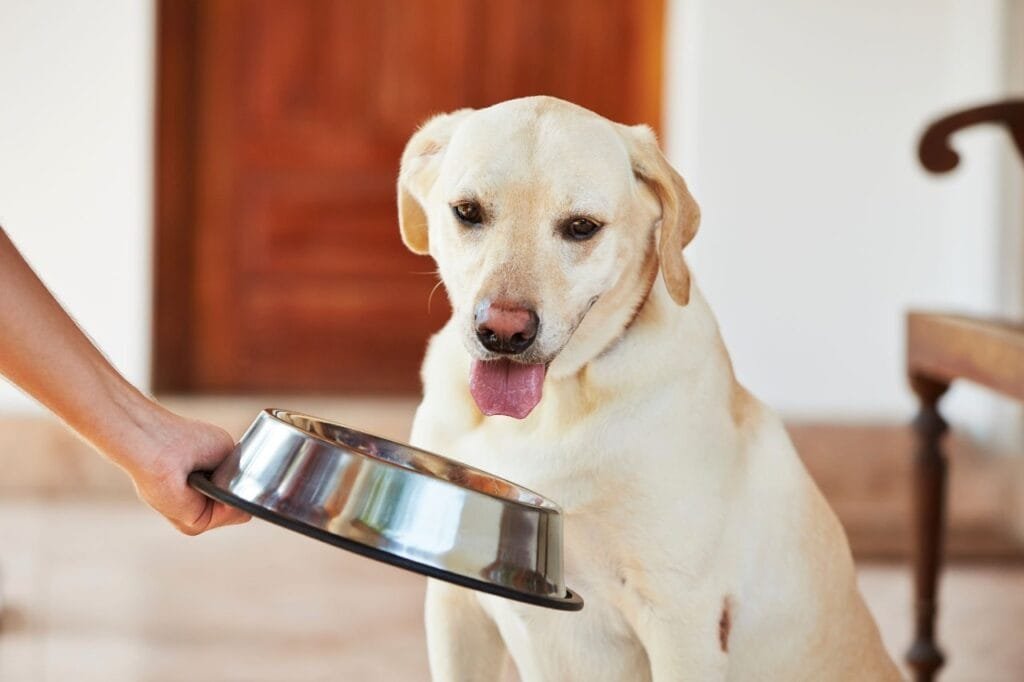
If your dog inhales every meal and, five minutes later, stares at you like you’ve personally wronged them — that’s breed-standard behavior, not a sign you’re underfeeding.
Golden Retrievers are famously food-motivated, and that instinct makes portion control both more important and more confusing for owners.
Here’s the short answer before we go deeper:
How much does a Golden Retriever eat? A healthy adult Golden Retriever typically eats between 2 and 3½ cups of dry kibble per day, split into two meals.
The exact amount depends on the dog’s age, weight, activity level, and whether they’ve been spayed or neutered.
Puppies need more frequent, smaller meals adjusted every few weeks as they grow.
That range covers most dogs.
But “most dogs” isn’t good enough if yours is at one extreme — a sedentary 75-lb male who’s been neutered needs a very different portion than an active 55-lb female who hasn’t been.
Let’s break this down properly.
Why Golden Retrievers Are Especially Hard to Feed Correctly
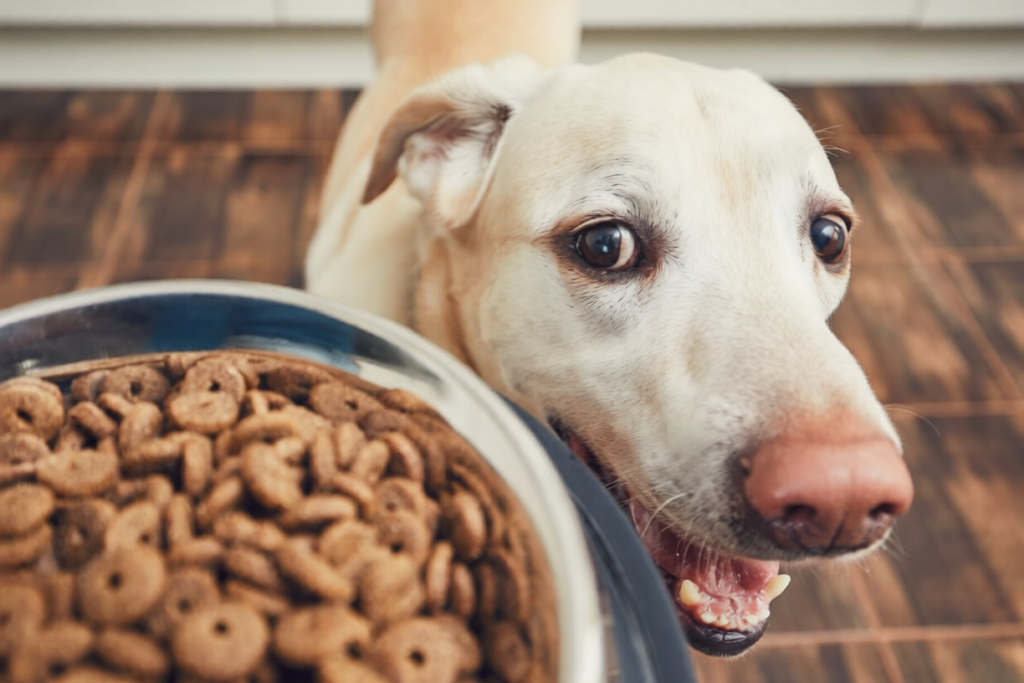
Most dogs will stop eating when full. Goldens often won’t.
According to data collected by the Association for Pet Obesity Prevention and cited in the Morris Animal Foundation’s Golden Retriever Lifetime Study (2016), nearly 63% of Golden Retrievers are overweight or obese.
That’s not a rounding error. That’s the majority of the breed carrying excess weight — and most of their owners don’t realize it.
A 2023 survey by APOP found that only 17% of dog owners correctly recognize when their pet is overweight.
The rest either don’t know or have normalized what a heavy Golden looks like because so many Goldens around them look the same way.
Here’s the thing: Overfeeding a Golden doesn’t just mean a chubby dog. Excess weight accelerates joint deterioration — a serious concern for a large breed already predisposed to hip and elbow dysplasia.
Data cited in Parade Pets (2025) notes that lean Goldens delay the onset of osteoarthritis by an average of two years and live roughly 1.8 years longer than overweight counterparts.
For a breed with an average lifespan of 10–13 years, that’s substantial.
The dog food bag isn’t your friend here, either.
Feeding guidelines on most kibble bags are calibrated for an average active dog — and they tend to run high.
Multiple rescue and breeder sources, including the Golden Retriever Rescue of Mid-Florida, have noted that most commercial feeding guidelines result in overfeeding for this breed specifically.
Golden Retriever Feeding Chart by Age and Weight
The table below gives real-world starting points — not the inflated figures from most bag labels.
These are based on a standard 350–380 kcal/cup kibble.
If your food has a significantly different caloric density, adjust proportionally.
Quick Comparison — Golden Retriever Daily Feeding by Life Stage
| Life stage | Age | Typical weight | Daily amount | Meals/day |
|---|---|---|---|---|
| Young puppy | 8–12 weeks | 8–15 lbs | ¾ – 1½ cups | 3 |
| Puppy | 3–6 months | 15–40 lbs | 1½ – 2½ cups | 3 |
| Adolescent | 6–12 months | 40–65 lbs | 2 – 3 cups | 2–3 |
| Adult (active) | 1–7 years | 55–75 lbs | 2½ – 3½ cups | 2 |
| Adult (sedentary) | 1–7 years | 55–75 lbs | 2 – 2¾ cups | 2 |
| Senior | 8+ years | 55–75 lbs | 1¾ – 2½ cups | 2 |
Quick note: Spayed and neutered adults should sit at the lower end of their range (more on that below). And females generally eat 15–20% less than males of the same age and activity level.
How to Feed a Golden Retriever Puppy (8 Weeks to 12 Months)
Puppies need more calories per pound than adults — but they also need controlled growth, which is a distinction most first-time owners miss.
Overfeeding a large-breed puppy doesn’t just make them fat. It makes them grow too fast.
Rapid skeletal growth increases the risk of developmental orthopedic conditions, including hip dysplasia and osteochondrosis.
Summer Brook Goldens, a breeder with documented feeding research, notes that two puppies from the same litter raised in different homes can diverge significantly in growth rate based purely on feeding amount — even if neither looks visually overweight.

To feed a Golden Retriever puppy correctly:
- Start at ½ cup three times daily for an 8–12 week old puppy
- Increase to 2–2½ cups total (split across 3 meals) by 3 months
- Scale up gradually to 2½–3 cups total by 5–6 months
- Transition to 2 meals per day between 6–9 months
- Reassess at 12–14 months — caloric needs drop sharply at this point
The rib check matters at every stage. You should be able to feel your puppy’s ribs with light finger pressure but not see them.
If you can see ribs, increase the food slightly. If you can’t feel them without pressing, cut back.
Golden puppies appear starved. That’s not a reliable hunger signal — it’s breed personality. You must learn to ignore the eyes.
Adult Golden Retriever Food Portions: The Spay/Neuter Factor Nobody Talks About
Most feeding guides give you a number. Few of them adjust that number for one of the most common variables in domestic dog ownership: whether your dog has been altered.
This is the gap. Here’s what the research actually says.
A 2019 study published in PLOS ONE, drawing on data from over 3,000 dogs in the Morris Animal Foundation Golden Retriever Lifetime Study, found that spayed or neutered Golden Retrievers were 50% to 100% more likely to become overweight or obese compared to intact dogs — regardless of the age at which the procedure was performed.

The mechanism is straightforward: spaying/neutering reduces metabolic rate and, in many dogs, increases appetite drive.
As a result, a dog eating the same portion as before surgery gradually gains weight.
Or maybe I should say it this way: the portion that kept your dog lean before surgery is no longer the right portion after surgery.
It’s not your dog gaining weight “for no reason.” The math genuinely changed.
Practical adjustment: After spaying or neutering, reduce daily food intake by approximately 20–25% from the pre-surgery baseline and monitor body condition monthly.
Most intact-dog feeding tables should be recalibrated downward for altered dogs.
Some experts argue that intact dogs live healthier lives due to hormonal benefits. That’s valid in certain contexts.
But if you’ve decided to alter your Golden — which most pet owners do — you need to adjust its feeding accordingly, or you’re working against the metabolic reality of your dog’s body.
How to Know If You’re Feeding the Right Amount (Body Condition Scoring)
The scale is one data point. It’s not the whole picture.
Body condition scoring (BCS) is the tool veterinarians use to assess whether a dog is carrying the right amount of fat, regardless of raw weight.
A large-framed male can weigh 80 lbs and be perfectly lean. A small female can weigh 65 lbs and be obese.
The number alone doesn’t tell you which is which.
Here’s a simple at-home BCS check:
Run both hands along your dog’s ribcage from shoulder to hip.
You should feel individual ribs with light pressure — no digging required, but no ribs visible through the coat either.
Looking from above, there should be a visible waist narrowing behind the ribs.
From the side, the abdomen should tuck up slightly rather than hanging level or drooping.
If ribs are hard to feel and the waist has disappeared, your dog is likely overweight. Reduce daily food intake by ¼ cup and recheck in 3 weeks.
If ribs are very prominent with no fat cover, increase food by ¼ cup and recheck.
Do this monthly. Not just when you think something is wrong.
Which Dog Foods Work Best for Golden Retrievers
The feeding amounts above assume a standard-quality dry kibble with roughly 350–380 kcal per cup. Not all kibble hits that range.
A few products worth mentioning specifically for Goldens:
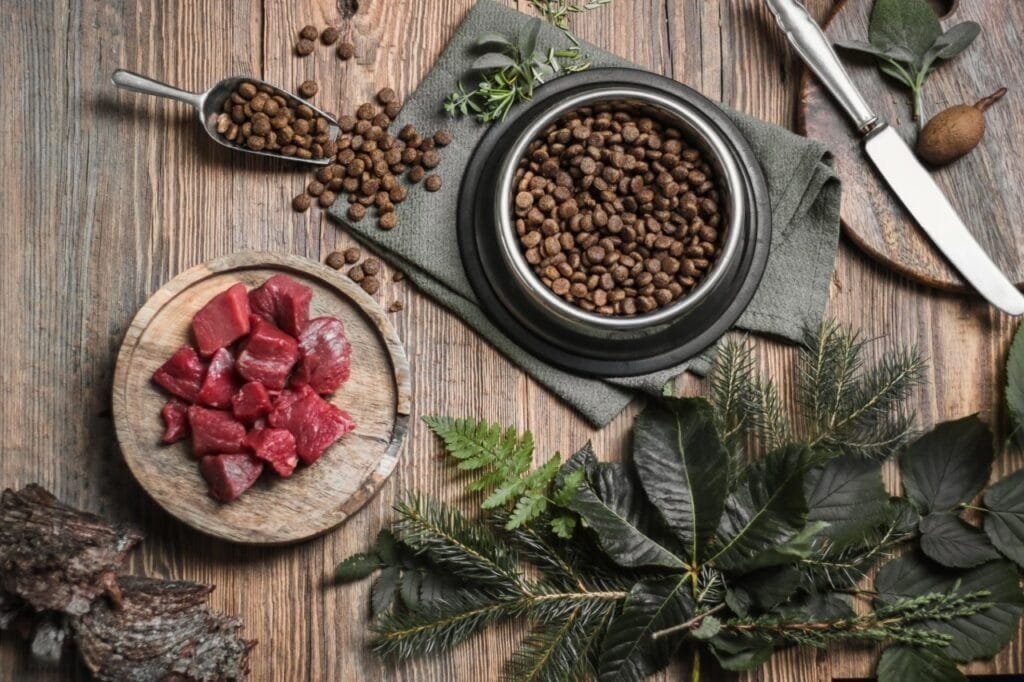
Royal Canin Golden Retriever Breed-Specific: formulated with this breed’s joint, coat, and cardiac health in mind.
The kibble shape is also designed for the Golden’s jaw structure. It runs around 354 kcal/cup, which aligns well with the portion ranges above.
Hill’s Science Diet Large Breed Adult: frequently recommended by veterinarians for weight management in large breeds.
Lower caloric density makes portion control slightly more forgiving, and it’s one of the few large-breed formulas with published feeding trials.
KONG Wobbler or similar puzzle feeder: not a food, but worth mentioning here. Goldens eat fast, which both reduces satiety signaling and increases bloat risk.
A puzzle feeder can slow a meal from 45 seconds to 8–10 minutes with zero changes to portion size.
Owners who’ve tried this often report their dog seems more satisfied after meals — because the eating experience actually lasted long enough to register.
I’ve seen conflicting data on whether wet food supplementation genuinely helps with satiety in Goldens, or just adds calories with a satisfaction illusion.
My read is that wet food as a topper adds palatability more than it adds fullness — and for a breed already prone to overeating, that’s worth being careful about.
Feeding Senior Golden Retrievers (Age 8 and Up)
Older Goldens need fewer calories. Simple. But most owners don’t reduce portions when their dog hits senior age, especially if the dog is still acting energetic.
Activity levels drop before the dog visibly slows down. Metabolism declines. Muscle mass begins to decrease even as fat increases.
The result is a dog who looks roughly the same but is actually trending toward poor body condition.
Reduce daily calories by 10–20% when your Golden turns 8, or earlier if they’ve been diagnosed with any joint, thyroid, or metabolic condition.
Switch to a senior or “mature” formula if your current food doesn’t have a breed-appropriate alternative.
What most senior feeding guides skip: protein needs actually stay high or increase in senior dogs, even as total caloric needs drop.
Don’t swap to a low-protein senior food without checking the protein percentage. Muscle maintenance requires adequate protein.
A senior formula with reduced fat but maintained protein is the right direction.
Note: Senior feeding becomes significantly more individual and condition-dependent. The ranges above are starting points — a senior Golden with kidney disease, hypothyroidism, or heart issues needs a vet-directed feeding plan, not a general guide.
FAQs
How many cups of food should I feed my Golden Retriever per day?
Most adult Golden Retrievers need 2 to 3½ cups of dry kibble daily, split into two meals. Spayed or neutered dogs should eat toward the lower end of that range.
How much should I feed a Golden Retriever puppy?
Start at ½ cup three times daily at 8 weeks, scaling up to roughly 2½–3 cups total per day by 5–6 months. Always use body condition — not hunger cues — to guide adjustments.
Should I feed my Golden Retriever once or twice a day?
Twice daily is best for adults. It reduces hunger-related behavior, lowers bloat risk compared to one large meal, and keeps energy levels more stable across the day.
Why does my Golden Retriever always act hungry?
Golden Retrievers are genetically food-motivated and rarely self-regulate their intake. Acting hungry shortly after eating is normal breed behavior, not evidence of underfeeding. Use the rib check, not the dog’s reaction, to calibrate portions.
When should I switch my Golden Retriever from puppy food to adult food?
Between 12 and 15 months. Goldens reach close to adult size by 12 months, and continuing puppy food past this point risks excess caloric intake during a period when their growth-phase metabolism is slowing down.
Conclusion
You have the numbers. Now use them.
Pick the daily amount that matches your dog’s age, weight, and activity level. Run it for three weeks.
Do the rib check. Adjust by a quarter cup based on what you feel — not what your Golden tells you with their eyes.
If your dog was recently spayed or neutered, drop portions by 20–25% now. Don’t wait for the weight to show up first.
Still unsure? Your vet is the right next call — especially if your dog is losing or gaining weight despite correct portions.
Got a Golden at home? Drop their age and how much you’re currently feeding in the comments — we’ll tell you if you’re in the right range.
Not a substitute for veterinary advice. Always consult your vet for dogs with diagnosed health conditions.
