


This guide covers healthy adult and growing Golden Retrievers. It does NOT address dogs with diagnosed conditions like kidney disease, pancreatitis, or severe food allergies — those cases need a veterinary nutritionist.
A balanced diet for a Golden Retriever is a daily feeding plan that supplies the right ratio of animal protein, healthy fats, digestible carbohydrates, vitamins, and minerals — adjusted for the dog’s age, weight, and activity level.
One sentence matters more than any other: what works for a 10-week-old puppy will actively harm a 9-year-old senior if you never change it.

Why Goldens Have Unique Nutritional Needs
Most dogs can survive on a generic large-breed formula. Goldens are different — and owners who treat them like “just a big dog” often find out the hard way.
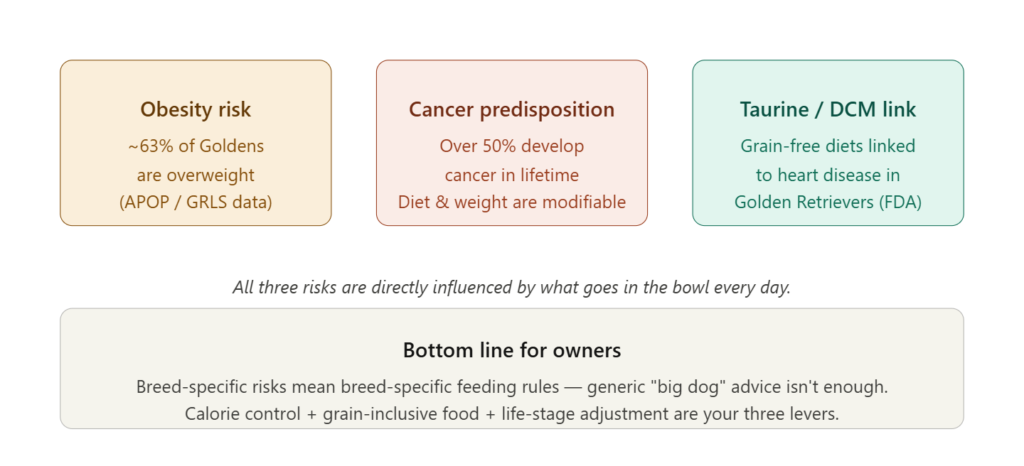
Here’s the thing: nearly 63% of Golden Retrievers are overweight or obese, according to data from the Association for Pet Obesity Prevention cited in the Morris Animal Foundation’s Golden Retriever Lifetime Study.
This 14-year, 3,000-dog longitudinal study is the largest of its kind in veterinary medicine. That’s not a minor stat.
It means the average Golden in the US is already overweight before its owner suspects a problem.
The breed also carries a documented genetic predisposition to hemangiosarcoma, lymphoma, osteosarcoma, and mast cell tumours.
Obesity drives systemic inflammation, and chronic inflammation raises cancer risk.
That chain is why nutrition isn’t just about a shiny coat — it’s a genuine health variable.
And then there’s the grain-free issue. Most guides skip this entirely.
What most guides skip: In 2018 and 2019, the FDA issued alerts identifying a potential link between grain-free diets and dilated cardiomyopathy (DCM), a serious heart condition, in dogs, with Golden Retrievers appearing disproportionately in the reports.
The suspected mechanism involves taurine deficiency.
Grain-free diets often substitute legumes (lentils, peas, chickpeas) for grains, and those legumes may interfere with taurine synthesis.
The science isn’t fully settled — some experts argue alternative variables are at play — but the FDA investigation is ongoing.
And the risk is real enough that most veterinary cardiologists now recommend grain-inclusive foods for Goldens specifically.
What a Balanced Golden Retriever Diet Actually Contains
Quick note: “balanced” has a legal definition in pet food. AAFCO (the Association of American Feed Control Officials) sets minimum nutrient profiles.
A food claiming to be “complete and balanced” has met those minimums — but minimums aren’t the same as optimal for a breed with specific risks.
Protein is non-negotiable. Adult Goldens need at least 18–22% crude protein on a dry matter basis, from a named animal source — chicken, lamb, salmon, turkey — listed first on the ingredient panel.
Vague terms like “poultry by-product meal” aren’t inherently dangerous, but they make it harder to verify what you’re actually feeding.
Fats matter for this breed, too.
Goldens are notorious for skin issues and coat dullness, and omega-3 fatty acids (specifically EPA and DHA from fish oil or fish-based ingredients) make a measurable difference.
Look for a fat content around 10–15% and an omega-6 to omega-3 ratio under 10:1 — most standard kibbles run 20:1 or higher, which contributes to inflammation over time.
Carbohydrates are the most misunderstood piece. The grain-free craze made many owners believe carbs were the enemy.
They’re not — but the source matters. Brown rice, oatmeal, and barley digest well and provide stable energy.
Corn and soy are more problematic for Goldens specifically, as a large proportion show sensitivity or allergy symptoms (hot spots, chronic ear infections, loose stools) with diets heavy in those ingredients.
Or maybe I should say it this way: the goal isn’t low-carb, it’s high-quality carb.
Feeding by Life Stage: Puppy, Adult, and Senior
Quick comparison — Golden Retriever feeding by life stage
| Life stage | Age range | Daily calories (approx.) | Meals/day | Key priority |
|---|---|---|---|---|
| Puppy | 8 weeks – 12 months | 1,200 – 1,600 kcal | 3–4 times | Controlled growth — NOT maximum growth. Large-breed puppy formula. |
| Adult | 1 – 7 years | 1,200 – 1,800 kcal depending on size & activity | 2 times | Calorie control. Target body condition score 4–5/9. 2 cups of premium kibble ≈ baseline. |
| Senior | 7+ years | 1,000 – 1,400 kcal | 2 times | Reduced calories for slower metabolism. Higher protein to preserve muscle. Joint supplements. |
Puppy (8 weeks – 12 months)
This is the stage where owners make the most consequential mistakes. Goldens grow fast.
The instinct is to feed them a lot to support that growth — but rapid growth in large breeds is actually the problem, not the solution.
Overfeeding a Golden Retriever puppy accelerates skeletal development faster than joints can handle, increasing the risk of hip dysplasia and osteochondrosis.
Use a formula specifically labelled for large-breed puppies. These foods are designed with a calcium-to-phosphorus ratio that slows bone growth to a safe pace.
Do NOT use adult food or all-life-stages food for a Golden puppy under 12 months — the calcium levels are different.
Feed 3–4 smaller meals daily rather than one large one. This reduces the risk of bloat (another Golden-specific concern) and maintains blood sugar stability.
To transition a puppy to a new food safely:
- Days 1–2: 75% old food, 25% new food.
- Days 3–4: 50/50 split.
- Days 5–6: 25% old, 75% new.
- Day 7+: 100% new food.
Each step should take no longer than 2 days. If loose stools appear, slow the transition.

Adult (1–7 years)
The adult phase is where feeding becomes a long-term discipline. Two meals per day is the standard — one in the morning, one in the evening.
Free-feeding (leaving food out all day) is not recommended for Goldens because of their appetite-regulation issues. They will overeat.
A standard 65-lb active adult Golden needs roughly 1,500–1,700 kcal per day. A sedentary 75-lb Golden needs closer to 1,200–1,400.
The bag feeding guide is a starting point — not a rule. Measure in cups, check body condition score monthly, and adjust.
Body condition score matters more than weight. Run your hands along your dog’s ribcage — you should feel the ribs easily without pressing hard.
If you can’t feel them, the dog is overweight regardless of what the scale says.
Grain-inclusive vs grain-free: which is better for adult Goldens?
Grain-inclusive diets with named protein as the first ingredient are currently the safer choice for this breed, given the FDA’s DCM investigation.
Grain-free may work fine for many individual dogs — but given the Golden’s documented cardiac vulnerability, the risk-benefit calculation favours grain-inclusive until the science settles.
Some experts argue that grain-free diets suit dogs with diagnosed grain allergies. That’s valid for that scenario.
But if your dog hasn’t been tested and you’re just following a trend, switching back to grain-inclusive is worth considering.
Senior (7+ years)
Metabolism slows. Activity decreases. But protein needs actually go up, not down, in senior dogs — because older dogs are less efficient at using dietary protein to maintain muscle mass.
The counterintuitive insight most guides miss: reducing protein intake in senior dogs to “protect the kidneys” is outdated advice unsupported by current evidence in healthy dogs.
It’s appropriate only for dogs with confirmed kidney disease. For healthy seniors, high-quality protein preservation is the priority.
Reduce total calories by roughly 20–25% from peak adult intake. Increase omega-3 supplementation for joint support.
Consider glucosamine and chondroitin supplementation — Royal Canin Golden Retriever breed-specific formula includes these at maintenance levels, though a veterinarian can advise on additional supplementation if the dog shows stiffness.
Specific Foods Worth Knowing About

Not all kibble is equal, and three products are consistently referenced in veterinary nutrition discussions for this breed.
Royal Canin Golden Retriever: A breed-specific formula designed with the Golden’s jaw shape, coat needs, and cardiac considerations in mind.
It uses a grain-inclusive formulation and contains EPA/DHA for coat health. Expensive, but purpose-built.
Hill’s Science Diet Large Breed: Widely recommended by vets, well-studied, grain-inclusive, and AAFCO-certified. Not Golden-specific but a solid default for adults and seniors.
Orijen Six Fish: High in omega-3s from multiple fish sources (herring, mackerel, flounder, redfish, monkfish, blue whiting).
Excellent for Goldens with skin issues or dull coats. Higher protein content means calorie-dense — portion control is essential.
I’ve seen conflicting data on raw diets — some holistic vets swear by them for coat quality and energy.
While most veterinary nutritionists point to contamination risks (salmonella, nutritional imbalance) and the absence of long-term safety data for large breeds.
My read: A well-formulated raw diet can work, but it requires a level of precision in preparation that most owners don’t sustain long-term.
For most Golden owners, a high-quality commercial kibble from one of the brands above is the safer, more consistent choice.
Foods to Avoid
Some of this is common knowledge. Some isn’t.
Avoid grain-free formulas dominated by lentils, peas, or chickpeas as the first or second ingredient — specifically because of the DCM link in Goldens.
Also, avoid anything with Ethoxyquin, BHA, or BHT as preservatives — these are suspected carcinogens and have no place in a breed already at elevated cancer risk.
Look for foods preserved with mixed tocopherols (vitamin E), rosemary, or vitamin C.
Human foods to keep away from any dog: grapes, raisins, xylitol (in peanut butter — check the label), macadamia nuts, chocolate, onions, and garlic. These aren’t debatable.
Quick note: Many owners think “grain-free” and “gluten-free” mean the same thing. They don’t. Gluten is a specific protein in wheat and barley.
A grain-free diet removes all grains — but a gluten-sensitive dog only needs to avoid wheat and barley, not rice or oats.
Distinguishing the two can save you from unnecessarily restricting your dog’s diet.
FAQs: What Golden Retriever Owners Actually Ask
What’s the best food for a Golden Retriever with itchy skin?
Start with a grain-inclusive food with salmon or fish as the first ingredient. Omega-3s (EPA/DHA) directly support skin barrier function. If itching persists after 8–10 weeks, consult a vet for an elimination diet to rule out specific protein allergies.
How do I know if my Golden Retriever is overweight?
Feel the ribs — they should be easily felt without pressing hard, but not visibly protruding. A body condition score of 4–5 out of 9 is ideal. If ribs require firm pressure to locate, your dog is likely overweight, regardless of their scale weight.
Should I feed my Golden Retriever a grain-free diet?
For most Goldens, no. The FDA’s ongoing investigation into grain-free diets and DCM (dilated cardiomyopathy) identified Golden Retrievers as disproportionately represented in reported cases. Until the science resolves, grain-inclusive formulas are the safer default for this breed.
Why does my Golden always act hungry?
Golden Retrievers have a genuine appetite-regulation issue — they’re wired to eat past the point of satiety. This is breed-typical, not a sign they’re underfed. Stick to measured portions, use a slow feeder if needed, and don’t interpret begging as hunger.
When should I switch my Golden Retriever to senior food?
Around 7 years, or when your vet notes reduced activity and metabolism changes. Don’t wait until visible weight gain — make the switch proactively and reduce total calories by about 20% from peak adult intake.
Conclusion
A healthy Golden Retriever diet isn’t about trends—it’s about balance, consistency, and adapting to your dog’s life stage.
Focus on high-quality protein, controlled calories, and grain-inclusive nutrition, while avoiding overfeeding and risky ingredients.
Monitor your dog’s body condition, adjust portions as needed, and rely on proven, vet-backed guidance.
Done right, proper nutrition supports a longer, healthier life for your Golden.
Always consult your veterinarian before making significant dietary changes, especially for puppies, pregnant dogs, or dogs with diagnosed health conditions. This article provides general nutritional guidance and is not a substitute for professional veterinary advice.
