


This guide covers healthy Golden Retrievers from puppyhood through senior years. It does NOT address dogs with diagnosed conditions like kidney disease, pancreatitis, or severe allergies — those cases need a vet-formulated plan.
By the Author: Tommy Nelson
What the Ideal Diet for a Golden Retriever Actually Looks Like
The ideal diet for a Golden Retriever is a nutritionally complete, high-protein, moderate-fat meal plan calibrated to their age, weight, and activity level — not the serving suggestion printed on the side of a bag.
That last part matters more than most owners realize.
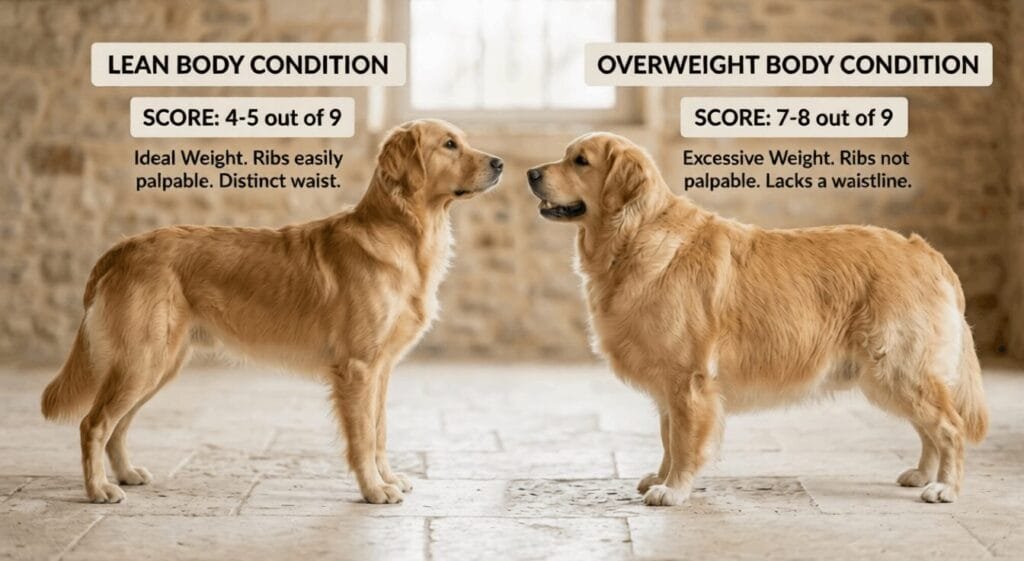
According to the Association for Pet Obesity Prevention (APOP), more than 60% of Golden Retrievers are overweight or obese.
The Morris Animal Foundation’s Golden Retriever Lifetime Study — which followed over 3,000 dogs longitudinally — confirmed this and found a direct link between sedentary lifestyle, early spay/neuter, and obesity risk.
Most people assume that following the bag’s feeding instructions is good enough. The data says otherwise.
Those guidelines are averages, and Goldens have an exceptionally strong food drive and a genuine genetic predisposition to weight gain.
Treating them like an average dog is how you end up at the vet discussing joint pain at age six.
Here’s the core framework before we break it down by life stage:
Quick Comparison: Diet Types for Golden Retrievers
| Option | Best For | Key Benefit | Limitation |
|---|---|---|---|
| High-quality dry kibble | Most owners, all life stages | Convenient, complete, affordable | Varies hugely in quality; high-carb options are common |
| Raw diet (BARF/pre-made) | Weight-conscious owners, food-motivated dogs | High protein, low carb, mimics ancestral diet | Expensive; requires careful sourcing or pre-made brand |
| Home-cooked meals | Dogs with multiple food sensitivities | Full ingredient control | Hard to balance without a veterinary nutritionist |
| Wet/canned food | Senior dogs, picky eaters, hydration support | High moisture, palatable | Calorie-dense; pricey at scale |
Feeding a Golden Retriever Puppy (8 Weeks to 12 Months)
Puppies aren’t just small adults. Their nutritional needs are genuinely different.
A Golden Retriever puppy needs food formulated for large-breed puppies — not generic puppy food, and definitely not adult food.
The distinction matters because large-breed puppy formulas control calcium and phosphorus ratios to prevent the too-rapid bone growth that can cause skeletal problems.
Standard puppy food often has excess calcium for a breed that’s going to hit 65–75 lbs.

How to feed a Golden Retriever puppy:
- Choose a large-breed puppy formula with named meat (e.g., “chicken,” not “poultry by-product”) as the first ingredient.
- Feed three meals per day from 8–16 weeks, then drop to two meals from 16 weeks onward.
- Measure portions by weight using a kitchen scale — cup measurements vary by kibble density.
- Adjust every 4 weeks as the puppy grows; don’t assume the same amount is correct month to month.
A rough starting point: 1.5–2.5 cups per day of a quality large-breed puppy kibble, split across meals.
But check the specific product’s guidelines for your puppy’s target adult weight and adjust from there.
Quick note: Avoid “all life stages” foods during puppyhood unless the label specifically states it meets AAFCO large-breed puppy nutrient profiles.
Many don’t.
Royal Canin Golden Retriever Puppy is one of the few breed-specific formulations that accounts for the Golden’s coat development (via omega-3s) and growth rate — worth considering if you want a formula where someone has already done the ratio work.
Feeding an Adult Golden Retriever (1 to 7 Years)
This is where most owners go wrong. Long-term.
An adult Golden typically needs 1,300–1,700 calories per day, depending on size, sex, activity level, and whether they’ve been spayed or neutered.
Here’s the thing: Neutered dogs have lower metabolic rates. The Morris Animal Foundation study found that Goldens neutered before six months had nearly double the obesity rate of intact dogs.
Yet almost no feeding guide adjusts its recommendations for this.

If your dog has been spayed or neutered, especially early, their maintenance calories are likely lower than any standard chart will show.
Or maybe I should say it this way: Your spayed female Golden and your intact male Golden of the same weight are not the same animal nutritionally.
Feeding them identically is a mistake.
Look — if you’ve been feeding your adult Golden what the bag says and they’re slowly gaining weight every year,
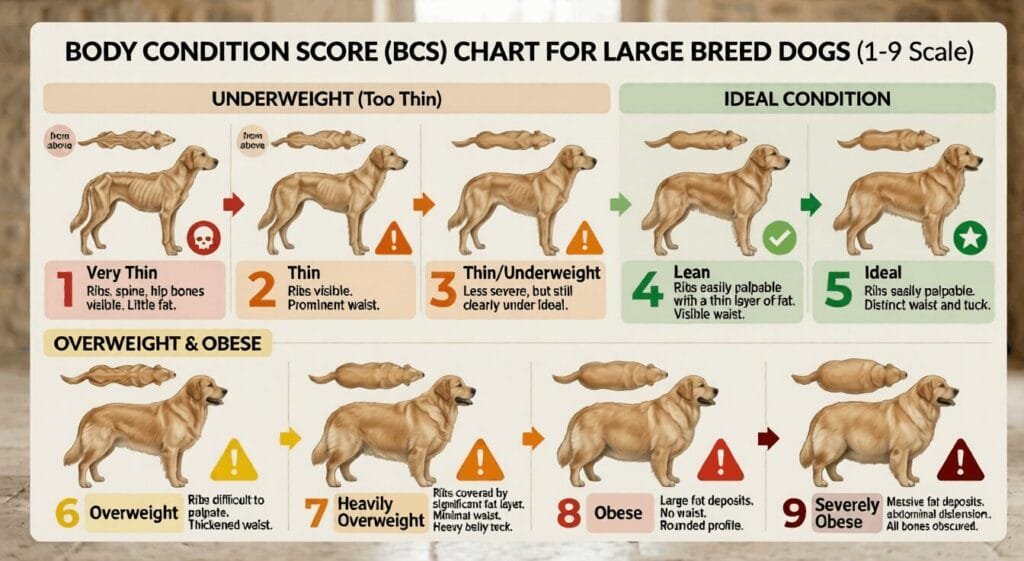
Here’s what actually works: Reduce portions by 10%, increase protein percentage, and add one additional walk per day. Track body condition score every 4 weeks, not the scale number alone.
For food, the key macros to target in an adult Golden’s diet:
- Protein: minimum 25% (dry matter basis) — ideally 28–32% from named animal sources
- Fat: 12–16% — enough for coat health without driving weight gain
- Carbohydrates: as low as practically possible, especially simple starches
Orijen Original meets these thresholds comfortably. It runs high — around 38% protein, 18% fat — so portion control is non-negotiable.
But it’s one of the few mainstream dry foods that approaches a biologically appropriate macro profile for this breed.
Some experts argue that raw diets are unnecessary and introduce food safety risks.
That’s valid for households with immunocompromised members or owners who can’t source reliably.
But if you can manage it, the high-protein, low-carb profile of a well-formulated raw diet — like We Feed Raw, developed by a PhD animal nutritionist and pre-portioned for convenience — addresses the two biggest dietary risk factors for Goldens (obesity and joint inflammation) more directly than most kibble options.
Feeding a Senior Golden Retriever (7 Years and Older)
Seven isn’t old for most breeds. For a Golden, it’s when you start paying closer attention.
Senior Goldens often need fewer total calories but more targeted nutrients: higher-quality protein to preserve muscle mass (which drops naturally with age), increased omega-3 fatty acids for joint support, and controlled phosphorus if kidney function is a concern.
Don’t automatically switch to a “senior” food — many are just lower-calorie versions of adult formulas with marketing language on the label.
I’ve seen conflicting data on this: some veterinary nutritionists argue that senior dogs need reduced protein to protect kidney health.
Others say the evidence for that is weak and that protein restriction in a dog without confirmed kidney disease is counterproductive.

My read is that, unless your vet has detected early kidney markers on bloodwork, maintaining protein quality while slightly reducing total calories is the more defensible approach for most senior Goldens.
What most guides skip is the hydration piece. Senior dogs often drink less water than they should, and dry kibble alone won’t compensate.
Adding warm water to kibble, mixing in a small amount of wet food, or transitioning partially to a high-moisture diet can make a real difference in kidney function and joint comfort in dogs over seven.
Specific senior diet priorities:
- Protein: 28–30% (dry matter) from highly digestible sources
- Omega-3s: look for EPA + DHA from fish oil, not just flaxseed
- Fiber: moderate — supports gut motility without causing loose stools
- Caloric density: reduce by roughly 20% from adult maintenance if activity has dropped
Foods Golden Retrievers Should Never Eat

Short list. Non-negotiable.
Grapes and raisins can cause acute kidney failure, even in small amounts. Xylitol (found in some peanut butters, sugar-free gum, and baked goods) causes rapid hypoglycemia.
Onions and garlic in any form damage red blood cells. Macadamia nuts cause neurological symptoms.
Cooked bones — not raw — can splinter and perforate the digestive tract.
Beyond the toxicity list: High-sodium processed human food, anything with artificial sweeteners, and corn-based treats used as meal toppers all contribute to the slow metabolic drift that ends up showing as unexplained weight gain over 18–24 months.
How to Read a Dog Food Label (What Actually Matters)
Most owners scan the front of the bag. The front of the bag is marketing.
Flip it over.
The ingredients list is in descending order by pre-cooking weight, which means a food listing “chicken” first may have less actual protein than one listing “chicken meal” second, because chicken meal is already dehydrated and therefore more protein-dense by weight.
This trips up almost everyone shopping for the first time.
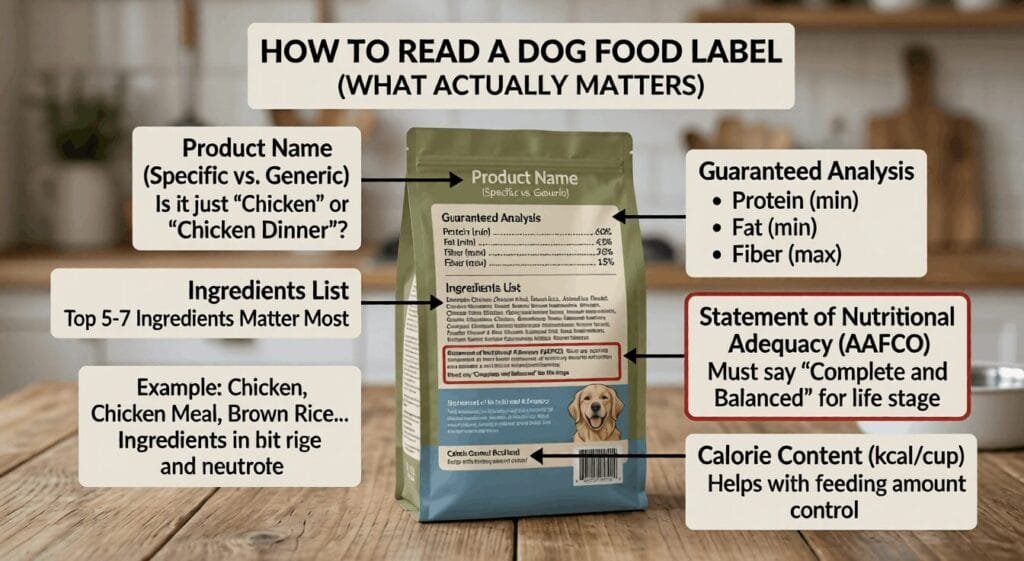
What to look for on the label:
- AAFCO statement: should say “complete and balanced” for your dog’s life stage — not just “formulated to meet.”
- Named protein source in the first two ingredients (e.g., “deboned salmon,” “chicken meal”)
- Omega-6 to Omega-3 ratio: ideally under 10:1 — most cheap kibble runs 15:1 or higher
- No “by-product meal” without a species name attached (e.g., “poultry by-product” is vague; “chicken by-product meal” is more traceable)
One counterintuitive insight: grain-free diets are not automatically better for Golden Retrievers.
The FDA investigated a potential link between grain-free diets high in legumes (peas, lentils) and dilated cardiomyopathy (DCM) in dogs between 2018 and 2022.
The science isn’t fully settled, but until it is, Goldens — who already carry some cardiac risk — are probably not the best candidates for heavy legume-based grain-free foods.
FAQs
What’s the best food for a Golden Retriever?
A high-protein, moderate-fat food formulated for large breeds — ideally with a named meat as the first ingredient and an AAFCO “complete and balanced” statement for your dog’s life stage. Royal Canin Golden Retriever Adult and Orijen Original are both commonly recommended by vets.
How much should I feed my Golden Retriever per day?
Adult Goldens typically need 1,300–1,700 calories daily, split into two meals. Spayed or neutered dogs often need 10–20% fewer calories than intact dogs of the same size. Always adjust based on body condition score, not just the bag’s suggestion.
Should I feed my Golden Retriever a raw diet?
A well-formulated raw diet can benefit Goldens by reducing carbs and supporting lean body mass — but it requires careful sourcing or a reputable pre-made option. It’s not necessary for every dog and isn’t suitable for every household. Talk to your vet before switching.
Why does my Golden Retriever always seem hungry?
Goldens are genetically food-motivated — some research suggests a variant in the POMC gene affects their satiety signaling. It doesn’t mean they need more food. Splitting meals into smaller, more frequent portions and using puzzle feeders can help manage food obsession without overfeeding.
When should I switch my Golden Retriever to senior food?
Around age 7–8, or earlier if your vet identifies age-related changes on bloodwork. Don’t switch automatically based on age alone — assess body condition, energy level, and health markers first. Some Goldens do better staying on a high-quality adult formula with added omega-3 supplementation.
Conclusion
Feeding a Golden Retriever well isn’t complicated — but it does require more attention than most owners expect going in.
The breed is genuinely predisposed to obesity, joint problems, and food obsession. None of that is the dog’s fault, and none of it is inevitable.
What it means is that the default approach — buy a bag, follow the label, repeat for seven years — isn’t going to cut it for this specific breed.
Pick a food that leads with real protein, matches your dog’s life stage, and sits within a macro profile your vet would actually approve of.
Measure portions.
Adjust every few months as your dog ages, gains muscle, loses activity, or goes through a hormonal change like spaying or neutering.
Check body condition score — not just the number on the scale — every four weeks.
That’s it. No magic diet. No expensive supplements required by default.
The Goldens that stay lean, mobile, and energetic into their senior years almost always have one thing in common: an owner who paid attention early and kept paying attention.
You’re already doing that by being here.
Disclaimer: This article is for general informational purposes and does not replace veterinary advice. Always consult your vet before making significant changes to your dog’s diet, especially if your Golden has an existing health condition.
