


This guide covers healthy adult and growing Golden Retrievers. It does NOT address dogs with diagnosed conditions like kidney disease, pancreatitis, or severe food allergies — those cases need a board-certified veterinary nutritionist.
By the Author: Tommy Nelson
Here’s what most articles on this topic won’t tell you up front: what’s right for a 10-week-old Golden Retriever will actively harm a 9-year-old one if you don’t adjust.
Feeding a senior the same high-calorie puppy formula you started with isn’t just imprecise.
It’s a real health risk for a breed that’s already predisposed to obesity-linked cancer.
Let’s dive in and break down exactly what makes the Golden Retriever diet & nutrition unique.
What Is a Balanced Golden Retriever Diet?

Golden Retriever diet and nutrition means a daily feeding plan with balanced animal protein, healthy fats, digestible carbohydrates, vitamins, and minerals—calibrated for age, weight, and activity.
Breed-appropriate diets target the Golden’s joint vulnerability, tendency toward obesity, and risk from taurine-deficient grain-free diets.
That last point matters more than most owners realise. We’ll get to it.
Why Goldens Have Unique Nutritional Needs
Most large breeds can survive on a decent generic kibble. Goldens are a different case — and owners who treat them like “just a big dog” often find out the hard way.
According to the Morris Animal Foundation’s Golden Retriever Lifetime Study — a 14-year, 3,000-dog prospective cohort and the largest canine health study in veterinary history — 37% of enrolled Goldens were classified as overweight or obese.
Higher adult body weight was directly associated with increased odds of cancer diagnosis, particularly hemangiosarcoma (PMC, 2022; updated findings 2025).
That’s not a minor footnote. That’s nearly 4 in 10 Goldens already overweight before their owners suspect a problem.
The breed also carries a documented genetic predisposition to hemangiosarcoma, lymphoma, osteosarcoma, and mast cell tumours.
Obesity drives systemic inflammation. Chronic inflammation raises cancer risk.
That chain is why what goes in the bowl isn’t cosmetic — it’s a genuine health variable for this breed specifically.
Read More:
- Golden Retriever Feeding Chart by Age (The One Vets Use)
- Can Golden Retrievers Be White? The Truth Behind the Myth
- 7 Natural Food Upgrades for Golden Retrievers That Work
The Grain-Free Warning Most Guides Skip
Quick note: this section is the one nearly every article ignores, and it’s arguably the most important safety topic in Golden Retriever nutrition right now.
In 2018 and 2019, the FDA issued alerts identifying a potential link between grain-free diets and dilated cardiomyopathy (DCM) — a serious, often fatal heart condition — in dogs.
Golden Retrievers appeared disproportionately in those case reports.
The suspected mechanism: grain-free diets typically replace grains with legumes (peas, lentils, chickpeas).
Those legumes may interfere with taurine synthesis or absorption. Taurine deficiency, in turn, is associated with DCM.
The science isn’t fully settled — some researchers argue that other dietary variables are at play.
I’ve seen conflicting data on exactly which legume concentrations are problematic, and the FDA investigation is ongoing as of this writing.
My read is this: the risk is real enough that most veterinary cardiologists now recommend grain-inclusive formulas for Goldens specifically, not grain-free ones.
If your dog is currently on a grain-free diet and showing any fatigue, exercise intolerance, or breathing changes, speak to your vet before making any switch.
Counter-intuitive insight: Most owners assume grain-free = healthier and more “natural” for dogs. The data for Goldens specifically says the opposite.
Whole grains like brown rice, oatmeal, and barley are not fillers — they’re legitimate, digestible carbohydrate sources that don’t carry the taurine-disruption risk associated with high-legume formulas.
Read More:
- Raw Food Diet for Golden Retrievers: Secret Rules That Work
- Best Diet for Golden Retriever Puppies: 5 Costly Mistakes
- Best Diet for Golden Retriever Health Improvement: 2026 Vet Guide
Feeding by Life Stage: Exact Calories and Schedules
This is the section most guides provide in vague generalities. Here are the actual numbers.

Puppy (8 Weeks – 12 Months)
Golden Retriever puppies have dramatically higher caloric needs than adults — roughly 55–60 calories per pound of body weight per day.
A 3-month-old puppy weighing 25 lbs needs approximately 1,375–1,500 kcal daily.
Feed puppies 3 times per day until 6 months, then transition to twice daily.
This matters: large-breed puppies fed once daily are more prone to bloat (GDV), a potentially life-threatening condition.
What to look for on the label: Choose a food that meets AAFCO nutritional profiles for “growth” or “all life stages” — not just “maintenance.”
Large-breed puppy formulas are preferable because they’re calibrated for controlled bone growth.
Rapid growth caused by excess calcium is actually harder on a Golden’s developing joints than lean, steady growth.
Adult (1–7 Years)
Adult caloric needs split by activity level:
| Activity Level | Calories Per Pound Per Day | Example: 65 lb Golden |
|---|---|---|
| Non-active / sedentary | 25–30 kcal/lb | ~1,625–1,950 kcal/day |
| Moderately active | 30–35 kcal/lb | ~1,950–2,275 kcal/day |
| Highly active (working dog) | 35–40 kcal/lb | ~2,275–2,600 kcal/day |
Quick Comparison — Grain-Inclusive vs Grain-Free for Adult Goldens:

Grain-inclusive (rice, oatmeal, barley) is better suited for Goldens because it doesn’t disrupt taurine metabolism and carries no DCM risk flag.
Grain-free works better when a dog has a confirmed grain allergy — which is far less common than marketing suggests.
The key difference is cardiac risk: grain-inclusive wins for this breed unless a specific allergy diagnosis says otherwise.
Feed adults twice daily rather than once. Split total daily calories evenly between morning and evening.
This reduces bloat risk and helps regulate blood sugar and energy levels throughout the day.
How to Use the Purina Body Condition Score (BCS)
The Purina BCS is a 9-point scale vets use to assess ideal weight. You can use it at home without a scale:
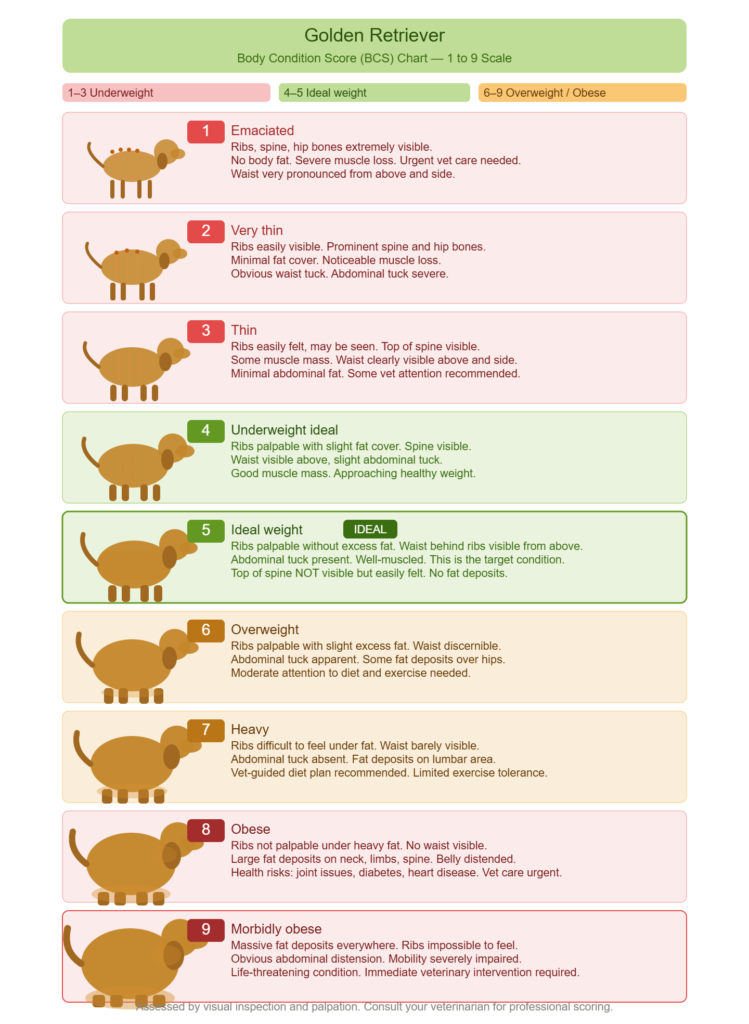
- Look at your dog from above: you should see a slight waist behind the ribs.
- Run your hands along the ribcage: you should feel ribs easily with light pressure, but not see them.
- Look from the side: there should be a visible abdominal tuck behind the ribs.
A score of 4–5 out of 9 is ideal. Score 6–7 = overweight. Score 8–9 = obese. If your Golden scores 6 or above, it’s time to speak to your vet about a controlled reduction plan.
Senior (7+ Years)
Look — if you’re in the “my Golden is slowing down” situation, here’s what actually works.
Senior Goldens need fewer total calories (roughly 20–25% less than their adult peak) but the same or higher protein levels to preserve muscle mass. This surprises many owners.
The instinct is to cut protein in older dogs, but current veterinary nutrition consensus says the opposite for healthy seniors without kidney disease: maintain protein, cut fat and overall caloric density.
Switch to a senior formula around age 7–8, or when your vet notes muscle condition changes.
Supplements worth discussing with your vet at this stage: omega-3 fatty acids (EPA and DHA from fish oil) for joint support and coat health, and glucosamine/chondroitin if your Golden shows early signs of hip dysplasia, which the breed is prone to.
Read More:
- Improve Your Golden Retriever’s Diet Naturally In (5 Steps)
- Is Chicken Good for a Golden Retriever’s Diet? Vet’s Truth
- Golden Retriever Diet & Nutrition: Complete Feeding Guide by Life Stage
Foods to Include and Foods to Absolutely Avoid

What a Balanced Bowl Includes
Your Golden needs five macronutrient categories at every life stage:
- Protein (chicken, turkey, salmon, lamb) supports muscle maintenance and immune function.
- Healthy fats (salmon oil, flaxseed, chicken fat) contribute to coat health and anti-inflammatory function.
- Digestible carbohydrates (brown rice, oatmeal, barley, sweet potato): sustained energy without the DCM risk of legume-heavy substitutes
- Fibre (pumpkin, broccoli, carrots) supports gut motility and healthy digestion.
- Vitamins and minerals, calcium and phosphorus for bone density, zinc for skin, and vitamin E for immune support
Or maybe I should say it this way: you’re not just buying “protein content” off a label. You’re buying the source of that protein.
Chicken meal and whole chicken both count as protein — but whole chicken contains far more moisture, so the actual protein density per cup differs significantly.
Check the guaranteed analysis panel, not just the ingredient list.
Toxic foods — No Exceptions
Never feed a Golden Retriever any of the following, regardless of quantity:
- Grapes and raisins (can cause acute kidney failure — mechanism still not fully understood, but the risk is confirmed)
- Xylitol (in peanut butter; sugar-free products cause a dangerous insulin spike)
- Onions and garlic (destroy red blood cells at sufficient doses)
- Macadamia nuts (neurological symptoms within 12 hours)
- Chocolate (theobromine toxicity)
- Cooked bones (splinter risk; raw bones are a separate, contested conversation)
- Alcohol, caffeine, avocado
What most guides skip: Xylitol is increasingly common in “natural” peanut butter brands. Always check the ingredients on any peanut butter before using it as a training treat.
Read More:
- How Much Protein Does a Golden Retriever Need Daily (With Real Gram Numbers)
- Balanced Diet for a Golden Retriever: Full Feeding Guide
- How Much Does a Golden Retriever Eat? Feeding Guide by Age and Weight
The Best Commercial Foods for Golden Retrievers

Some experts argue that home-cooked or raw diets deliver optimal nutrition for Goldens.
That’s valid for owners who work with a board-certified veterinary nutritionist to formulate a complete recipe.
But if you’re dealing with a standard household schedule and a healthy dog, a well-chosen commercial kibble covers the bases effectively.
Three products worth knowing:
Royal Canin Golden Retriever: the only breed-specific formula designed specifically for Goldens.
The kibble shape is engineered to slow eating (which reduces bloat risk), and the formula targets coat, joint, and heart health simultaneously.
It’s grain-inclusive, which matters.
Hill’s Science Diet Large Breed: frequently recommended by vets and AAFCO-verified. Not Golden-specific, but a reliable, well-researched option at a lower price point than Royal Canin.
Hill’s Science Diet Adult 7+ Large Breed: the senior version, with reduced calorie density and maintained protein for muscle preservation.
How to Transition Foods Without Upsetting Your Golden’s Stomach

To switch dog foods without digestive upset, follow these steps:
- Days 1–3: Mix 75% old food with 25% new food
- Days 4–6: Mix 50% old food with 50% new food
- Days 7–9: Mix 25% old food with 75% new food
- Day 10+: Feed 100% new food
Watch for loose stools or vomiting during the transition. If symptoms appear, slow the process down by adding one more day at each stage.
Disclaimer: This article provides general nutritional information for healthy Golden Retrievers. It is not a substitute for advice from a licensed veterinarian or board-certified veterinary nutritionist. Dogs with existing health conditions require individualized guidance.
Read More:
- Best Food to Feed a Golden Retriever: Vet-Backed Guide for Every Life Stage
- Ideal Diet for a Golden Retriever That Vets Swear By
5 Questions Golden Retriever Owners Actually Ask
What’s the best food for a Golden Retriever with itchy skin?
Look for foods high in omega-3 fatty acids (salmon, flaxseed, fish oil) and consider a limited-ingredient diet if a food allergy is suspected. Consult your vet before eliminating protein sources — true food allergies are less common than environmental triggers.
How do I know if my Golden Retriever is overweight?
Use the Purina Body Condition Score at home — feel for ribs with light pressure and check for a visible waist tuck from above. If you can’t feel ribs easily, or there’s no waist definition, your dog is likely above ideal weight. A vet’s weigh-in confirms it.
Should I feed my Golden Retriever a grain-free diet?
Not without a specific medical reason. The FDA’s ongoing investigation links grain-free diets to DCM in dogs, with Goldens appearing disproportionately in case reports. Unless your vet has diagnosed a grain allergy, grain-inclusive formulas are the safer choice for this breed.
Why does my Golden always act hungry?
Goldens are genetically food-motivated and will signal hunger well past satiety. A consistent twice-daily schedule helps, as does choosing higher-fibre foods that support a feeling of fullness. Don’t interpret persistent begging as a sign you’re underfeeding — use the BCS to check actual body condition.
When should I switch my Golden Retriever to senior food?
Around age 7–8, or earlier if your vet notices a muscle condition decline. The transition should be gradual — mix 25% new food with 75% current food for 5–7 days, then 50/50, then 75/25, then full switch.
Conclusion
Goldens are easy to overfeed. They’ll convince you they’re starving an hour after dinner — don’t fall for it.
Get three things right: correct calories for their life stage, a grain-inclusive formula, and a body condition check every few weeks. That’s genuinely most of it.
The cancer-obesity link in this breed is real. But it’s also preventable with consistent portions and the right food. No complicated protocol needed.
Start where you are. Puppy? Nail the 3x daily schedule. Adult creeping up in weight? Cut 10–15% of daily calories and recheck in four weeks.
Senior slowing down? Talk to your vet about a high-protein, lower-calorie senior formula before muscle loss sets in.
That one conversation — backed by a BCS score you calculated yourself — will do more for your Golden’s longevity than any supplement on the market.
Sources: Morris Animal Foundation Golden Retriever Lifetime Study (PMC, 2022, updated 2025); FDA Grain-Free Diet DCM Investigation (ongoing); AAFCO Nutrient Profiles for Dog Foods; Purina Body Condition Score System.


