


Disclaimer: This article is for educational purposes only, has not been vet-approved, and is not a substitute for professional veterinary advice. Always confirm feeding amounts with your veterinarian, especially for puppies, senior dogs, or dogs with health conditions.
A 65-lb neutered Golden who sleeps 18 hours a day needs 2.5 cups. A 65-lb intact Golden training for field trials needs 4 cups.
Same weight, totally different calorie needs.
Generic feeding charts assign one number to all adult dogs. This ignores activity and metabolic differences.
This Golden Retriever feeding chart adjusts portions based on your dog’s actual age, weight, activity level, and spay/neuter status.
You’ll get age-specific feeding tables, the RER/MER formula vets use to calculate exact portions, and the body condition score system that tells you when to adjust.
A 6-month-old Golden weighing around 40 lbs needs about 3-3.5 cups of large-breed puppy food per day, split into 2-3 meals.
Adult Goldens need 2.5-4 cups daily, depending on weight and activity.
Key Takeaways:
- Spayed or neutered dogs need roughly 20% fewer calories than intact dogs at the same weight.
- Puppies need more calories per pound than adults, a 6-month-old Golden typically needs 3-3.5 cups/day, while adults need 2.5-4 cups depending on activity
- Use the RER/MER calculation formula (not just generic charts) to personalize portions based on your dog’s exact weight, age, and neuter status
- Large-breed puppy formulas are required for Goldens to prevent joint problems caused by too-fast growth
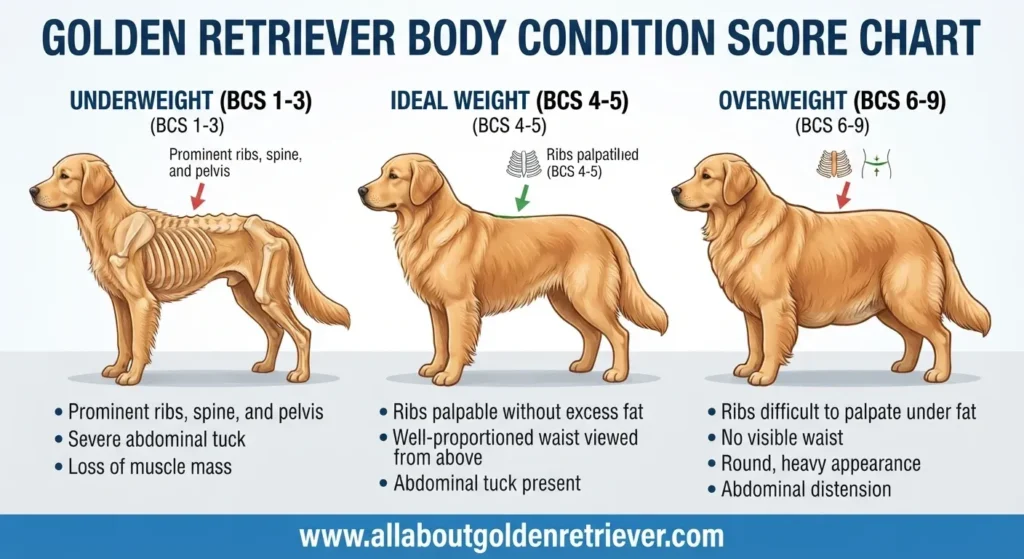
- Body condition score matters more than scale weight, ribs should be felt easily but not seen, with a visible waist from above
- Spayed/neutered dogs need roughly 20% fewer calories than intact dogs at the same weight
- Never free-feed Golden Retrievers, this food-motivated breed will overeat; stick to scheduled meals (2-4 times daily based on age)
- Treats count: Keep all treats under 10% of daily calories and subtract from meal portions
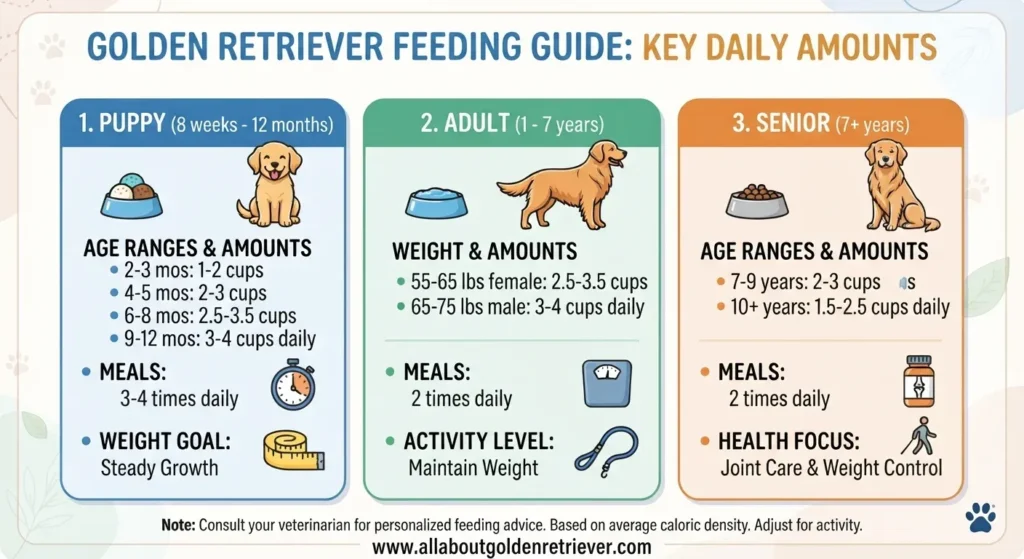
Golden Retriever Feeding Chart by Age
| Life Stage | Age | Typical Weight Range | Cups/Day (dry kibble) | Meals/Day |
|---|---|---|---|---|
| Puppy | 8–12 weeks | 10–20 lbs | 1.5–2.5 | 4 |
| Puppy | 3–5 months | 20–40 lbs | 2.5–3.5 | 3 |
| Puppy | 6–11 months | 40–65 lbs | 3–4.5 | 2–3 |
| Adult | 1–7 years | 55–75 lbs | 2.5–4 | 2 |
| Senior | 8+ years | 55–75 lbs | 2–3.5 | 2 |
Cup amounts assume a standard 8 oz measuring cup and kibble with 350–400 kcal per cup.
Caloric density varies by brand, so cross-check with your food bag’s feeding guide and the calorie formula below.
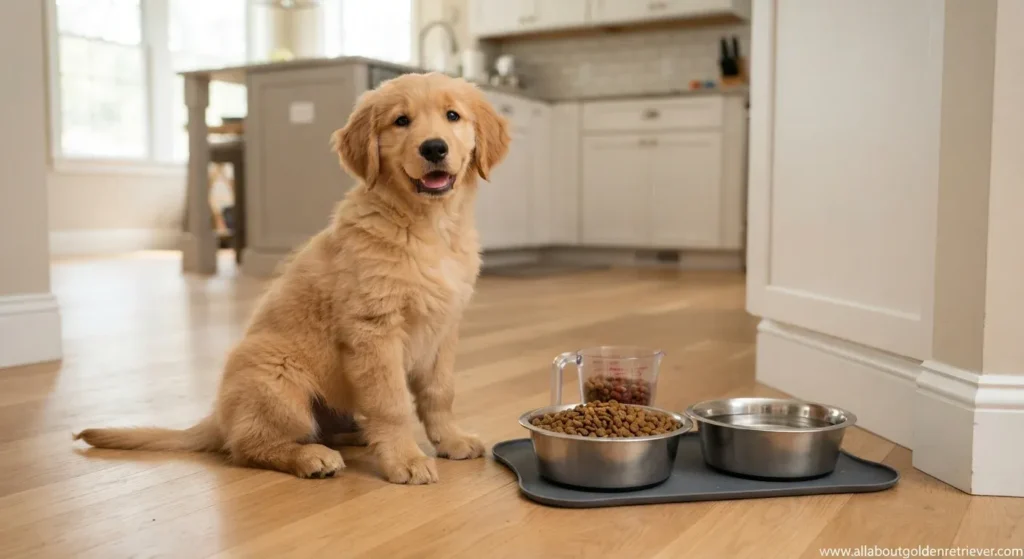
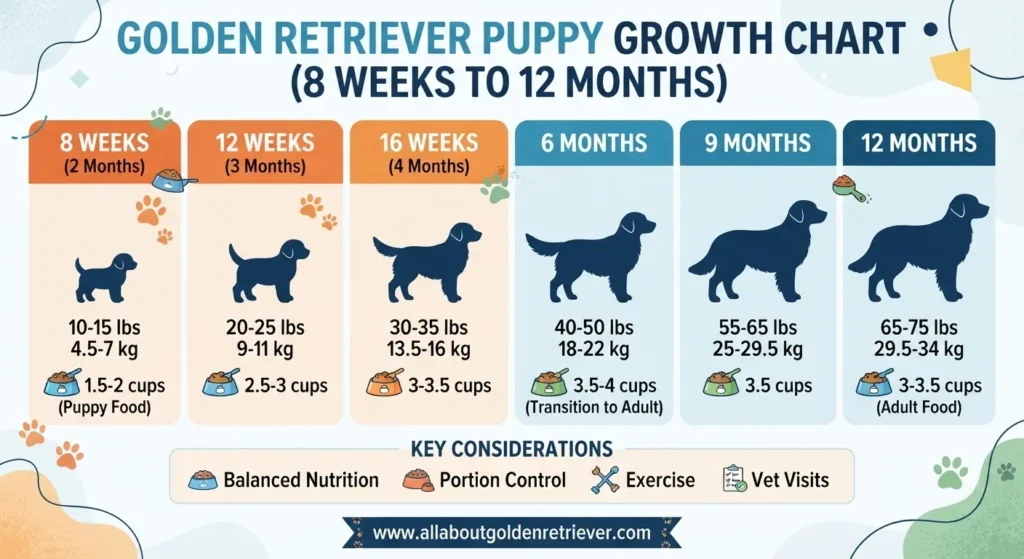
Golden Retriever Puppy Feeding Chart (8 Weeks–12 Months)
Puppies grow fastest in this window and are most at risk from over- or under-feeding.
Large-breed puppies like Goldens are sensitive to excess calories during rapid growth, which is linked to skeletal and joint problems later.
| Age | Weight (approx.) | Cups/Day | Meals/Day |
|---|---|---|---|
| 8 weeks | 10–12 lbs | 1.5–2 | 4 |
| 3 months | 20–25 lbs | 2.5–3 | 3–4 |
| 4 months | 25–35 lbs | 3–3.5 | 3 |
| 6 months | 35–45 lbs | 3–3.5 | 2–3 |
| 9 months | 50–60 lbs | 3.5–4 | 2 |
| 12 months | 60–70 lbs | 3–4 | 2 |
Always choose a food labeled for “large breed puppy” growth. These formulas control calcium and calorie density to support slower, joint-safe growth.
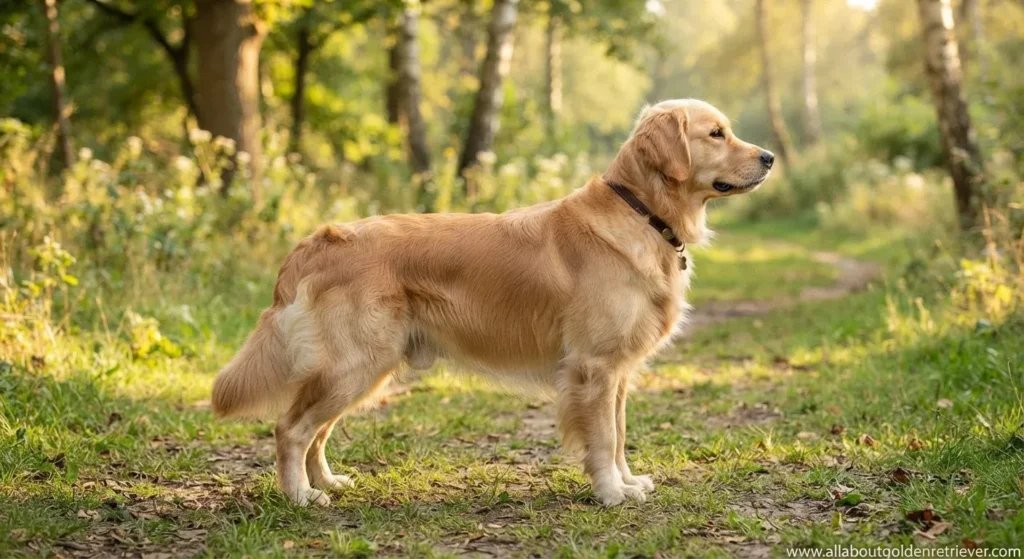
Adult Golden Retriever Feeding Chart
Once growth plates close (around 12–18 months), most Goldens transition to an adult maintenance formula.
Adult feeding amounts are driven by activity level and body condition.
| Weight | Low Activity | Moderate Activity | High Activity |
|---|---|---|---|
| 55 lbs | 2–2.5 cups | 2.5–3 cups | 3–3.5 cups |
| 65 lbs | 2.5–3 cups | 3–3.5 cups | 3.5–4 cups |
| 75 lbs | 3–3.5 cups | 3.5–4 cups | 4–4.5 cups |
Spayed or neutered adults generally need about 20% fewer calories than intact dogs at the same weight. Metabolic rate drops after the procedure.
Senior Golden Retriever Feeding Chart
Senior Goldens (typically 8+ years) tend to be less active and can lose muscle mass.
Many benefit from a senior formula with slightly fewer calories but more protein to preserve muscle.
| Weight | Cups/Day | Meals/Day |
|---|---|---|
| 55–60 lbs | 2–2.75 | 2 |
| 65–70 lbs | 2.75–3.25 | 2 |
| 75+ lbs | 3.25–3.75 | 2 |
Watch body condition score in senior dogs rather than relying on weight alone.
Arthritis and reduced mobility can mask early weight gain.
How to Calculate Exact Portions for Your Dog
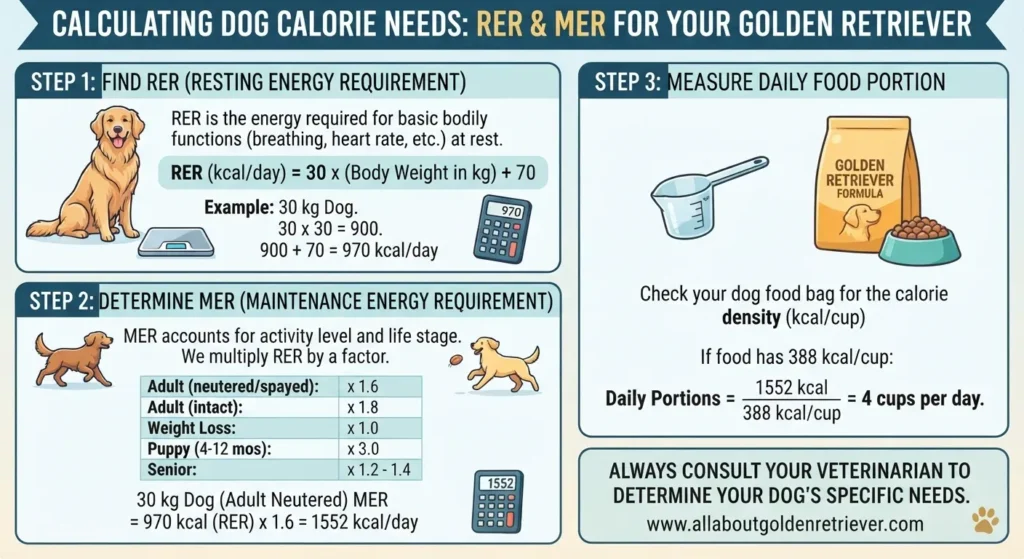
Charts give you a starting range. This formula gives you a number tailored to your specific dog.
Step 1: Calculate Resting Energy Requirement (RER)
RER (kcal/day) = 70 × (body weight in kg)^0.75
Step 2: Apply a life-stage/activity multiplier (MER)
| Category | Multiplier |
|---|---|
| Puppy (0–4 months) | 3.0 × RER |
| Puppy (4–12 months) | 2.0 × RER |
| Intact adult, moderate activity | 1.6 × RER |
| Neutered/spayed adult, moderate activity | 1.4 × RER |
| Weight loss needed | 1.0 × RER |
| Senior, less active | 1.2–1.4 × RER |
| Working/highly active adult | 2.0+ × RER |
Step 3: Convert calories to cups
Divide the daily calorie target (MER) by the kcal-per-cup value printed on your food’s packaging.
Caloric density varies by 20–30% between products, which is why two dogs at the same weight eating different brands can need different cup amounts.
Wet vs. Dry Food Portion Differences
Wet food is far less calorie-dense per cup than dry kibble (often 350–450 kcal/cup for dry vs. roughly 400–500 kcal per 13 oz can of wet food).
Portions aren’t interchangeable on a cup-for-cup basis.
If you’re mixing wet and dry, calculate the calorie contribution of each separately and combine them to hit your dog’s total MER target.
Signs You’re Overfeeding or Underfeeding
Check body condition score: ribs should be easily felt but not visible, with a visible waist from above.
Overfeeding signs: no visible waist, ribs hard to feel under fat, weight gain despite consistent activity, lethargy after meals
Underfeeding signs: ribs, spine, or hip bones visibly prominent, low energy, dull coat, slow or stalled growth in puppies
When to recalibrate: any time your dog’s weight shifts by more than 5–10% without a deliberate diet change, or after every vet weigh-in
If your dog is already overweight, recalculate MER using a 1.0× (weight-loss) multiplier and your dog’s target weight, not current weight. Reassess every 2–4 weeks.
Feeding Schedule (Meal Timing by Life Stage)
| Life Stage | Meals/Day | Suggested Timing |
|---|---|---|
| 8–12 weeks | 4 | Morning, midday, late afternoon, evening |
| 3–6 months | 3 | Morning, midday, evening |
| 6–12 months | 2–3 | Morning and evening (+ optional midday) |
| Adult | 2 | Morning and evening |
| Senior | 2 | Morning and evening, consistent timing |
Consistent meal timing helps with housetraining in puppies and supports stable digestion and energy levels in adult and senior dogs.
Don’t free-feed (leave food out all day). Golden Retrievers are food-motivated and prone to overeating when given unrestricted access.
Best Food Types for Golden Retrievers
Choose a food formulated for large breeds and matched to the correct life stage.
These formulas control calcium, phosphorus, and calorie density to support joint-safe growth and long-term joint health.
When comparing options, prioritize:
- Large-breed puppy formula (birth–12/18 months): controlled calcium (typically 1.0–1.8%) and calorie density to slow growth rate and protect developing joints
- Named animal protein first on the ingredient list (e.g., chicken, salmon, lamb) rather than a generic “meat meal”
- AAFCO statement of nutritional adequacy on the label, confirming the food meets complete-and-balanced standards for the intended life stage
- Omega-3 fatty acids (EPA/DHA), often from fish oil, to support coat, skin, and joint health
- Sensitive-stomach or limited-ingredient formulas if your dog shows food sensitivities, gas, or loose stools on a standard diet
- Joint-support additions (glucosamine, chondroitin) for adult and senior formulas, given the breed’s predisposition to hip and elbow dysplasia
Kibble caloric density varies between brands (roughly 300–450 kcal/cup), which is why the RER/MER calculation above should drive your final portion size.
Treats and the 10% Rule
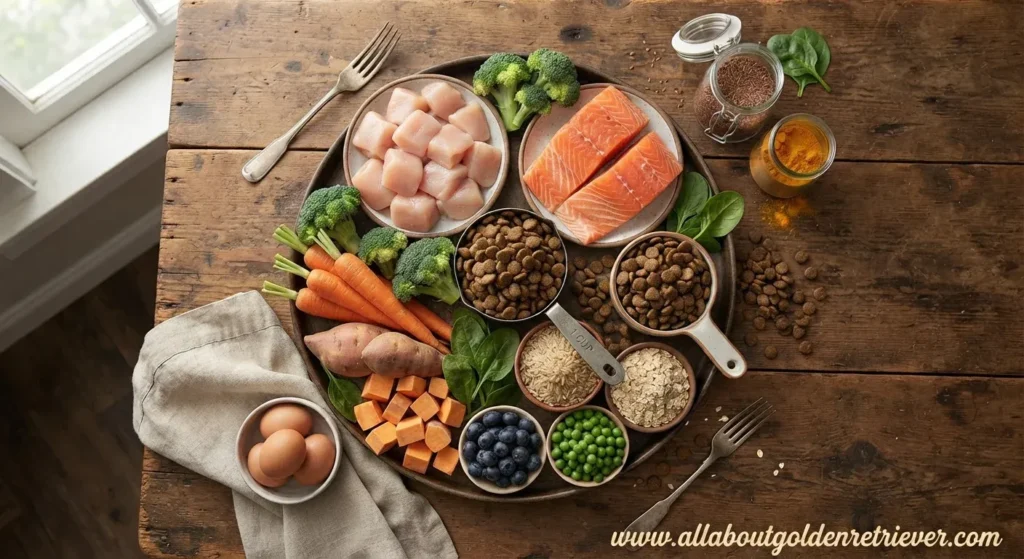
Treats (including training treats) should make up no more than 10% of your dog’s total daily calorie intake.
For a 40-lb Golden Retriever puppy eating roughly 1,400–1,600 kcal/day, that’s a ceiling of about 140–160 treat calories. Subtract that from meal portions.
FAQs
How many cups of food should a Golden Retriever eat?
Adult Golden Retrievers need 2.5–4 cups of dry food daily (split into two meals), depending on weight, activity level, and spay/neuter status. Puppies need proportionally more based on their current weight and growth stage.
How much should a 6-month-old Golden Retriever eat?
A 6-month-old Golden weighing around 40 lbs needs about 3–3.5 cups of large-breed puppy food per day, divided into 2–3 meals. Always use the RER/MER formula and your food’s calorie content for precise amounts.
Is one cup of food enough for a Golden Retriever puppy?
No. One cup per day is too little for a Golden Retriever puppy past the earliest weeks. This large breed requires steadily increasing calories—compare your puppy’s weight against the feeding chart above.
How often should I feed my Golden Retriever?
Puppies under 6 months need 3–4 meals daily. Puppies 6–12 months need 2–3 meals. Adults and seniors should eat twice daily on a consistent schedule.
Do spayed or neutered Golden Retrievers need less food?
Yes. Spayed/neutered Golden Retrievers need about 20% fewer calories than intact dogs at the same weight due to a lower metabolic rate. Use the 1.4× MER multiplier instead of 1.6×.
How much should an adult Golden Retriever eat per day?
Adult Goldens at a healthy weight need 2.5–4 cups daily, depending on body weight (55–75 lbs), activity level, and spay/neuter status. Calculate exact portions using the RER/MER formula.
What’s the difference between puppy food and adult food portions?
Puppy food is more calorie-dense per cup for growth, fed in smaller amounts more frequently (3–4 times daily). Adult food is for maintenance, fed twice daily in larger portions. Golden Retrievers should stay on large-breed puppy formula until 12–18 months.
Can I free-feed my Golden Retriever instead of scheduled meals?
No. Golden Retrievers are highly food-motivated and will overeat if free-fed. Scheduled meals (2–4 times daily based on age) help control portions, track intake, and prevent obesity.
How much water should a Golden Retriever drink alongside its food?
Golden Retrievers need about 1 ounce of water per pound of body weight daily (a 65-lb dog needs roughly 65 oz or 8 cups), more in hot weather or after exercise. Keep fresh water available at all times.
Conclusion
Feed your Golden Retriever using the charts and calculations in this guide as starting points.
If your dog’s weight fluctuates by more than 5–10%, energy level changes, or you notice signs of digestive upset, schedule a vet visit before making major diet changes.
Professional guidance is critical during the puppy growth window, when both overfeeding and underfeeding carry long-term skeletal risks, and in senior years when underlying health conditions can affect nutritional needs.
Combine the feeding charts, calculation methods, and monitoring techniques in this guide with regular veterinary checkups.

Resources
Veterinary & Nutritional Guidelines:
- American Animal Hospital Association (AAHA) – Nutrition and Weight Management Guidelines
- Association of American Feed Control Officials (AAFCO) – Pet Food Regulations
- World Small Animal Veterinary Association (WSAVA) – Global Nutrition Guidelines
- Pet Nutrition Alliance – Calorie Calculator for Dogs
Breed-Specific Health Information:
- Orthopedic Foundation for Animals (OFA) – Hip Dysplasia Database
- Golden Retriever Club of America – Health & Nutrition Resources
- American Kennel Club (AKC) – Golden Retriever Breed Information
Pet Food Safety & Recalls:
- U.S. Food and Drug Administration (FDA) – Pet Food Recalls
- ASPCA Animal Poison Control – Toxic Foods for Pets
Medical Disclaimer
This article is for educational and informational purposes only and has not been reviewed or approved by a licensed veterinarian.
The feeding guidelines, charts, and calculations are based on general veterinary nutritional principles and should not replace professional veterinary advice, diagnosis, or treatment.
Every Golden Retriever has individual nutritional needs that may vary based on health status, metabolism, activity level, and underlying medical conditions.
The feeding amounts suggested in this guide are starting points only.
Always consult with your veterinarian before:
- Making significant changes to your dog’s diet
- Determining appropriate portions for puppies during critical growth periods
- Feeding a dog with existing health conditions (diabetes, kidney disease, allergies, joint problems, etc.)
- Implementing a weight-loss program
- Selecting food for a pregnant or nursing dog
- Addressing feeding concerns in senior dogs
If your Golden Retriever shows signs of illness, sudden weight changes, appetite loss, digestive problems, or any other health concerns, seek immediate professional veterinary attention.
The authors and publishers of this content assume no liability for any decisions made based on the information provided herein.
Your veterinarian is your best resource for personalized, medical-grade feeding recommendations tailored to your individual dog.