


Most golden retriever owners make the same feeding mistake. They don’t even realize it. It shows up months later as a joint problem nobody saw coming.
The best diet for golden retriever puppies is a large-breed-specific puppy formula.
It needs controlled calcium — around 1.1–1.8% on a dry matter basis. The calcium-to-phosphorus ratio should sit near 1:1 to 1.3:1.
Feed it across three to four measured meals a day until about six months old.
That single sentence solves most of what new owners are panicking about at 11 pm with a confused puppy at their feet.
Here’s the thing: most feeding advice online treats every puppy the same. Goldens aren’t “every puppy.” They’re a large breed.
Hip and elbow dysplasia are common in this breed. What you feed them between 8 weeks and 18 months matters.
It has a direct, measurable effect on how their skeleton develops. The mistakes below are the ones that quietly cause the most damage.
They’re easy to avoid once you know what to look for.
What Makes a Diet Right for a Golden Retriever Puppy

A diet qualifies as “right” for this breed when it’s formulated for large-breed growth — not just “puppy food” in general.
Large-breed puppy formulas slow the growth rate slightly compared to standard puppy food. That’s intentional.
Fast bone growth in a heavy-boned breed like a golden is linked to higher rates of hip dysplasia and osteochondrosis.
According to a 2017 study published in PLOS ONE by Sandøe et al., golden retrievers kept lean during puppyhood showed significantly lower rates of joint disease than littermates allowed to grow at an unrestricted pace.
Purdue University’s long-running large-breed growth research backs this up: slower, steadier growth produces sturdier joints than rapid early weight gain.
Most people assume more protein and calcium during puppyhood means stronger bones.
The data says otherwise — excess calcium accelerates bone growth faster than the cartilage can support, which is exactly what causes the deformities owners are trying to avoid.
Quick Comparison
| Option | Best For | Key Benefit | Limitation |
|---|---|---|---|
| Purina Pro Plan Large Breed Puppy | Budget-conscious owners | Controlled calcium, widely available | Contains corn/by-products; some owners avoid |
| Royal Canin Golden Retriever Puppy | Breed-specific feeders | Tailored kibble shape and nutrient profile for goldens | Pricier per pound |
| Hill’s Science Diet Large Breed Puppy | Vet-recommended consistency | Backed by clinical research, gentle on digestion | Less “premium” ingredient marketing |
How Much to Feed a Golden Retriever Puppy by Age

To set portions correctly, follow these steps:
- Check your puppy’s current weight weekly.
- Match the weight to the feeding chart on your specific food bag.
- Split the daily total into 3–4 meals under 6 months.
- Reduce to 2 meals after 6 months.
- Adjust every 2 weeks as weight changes.
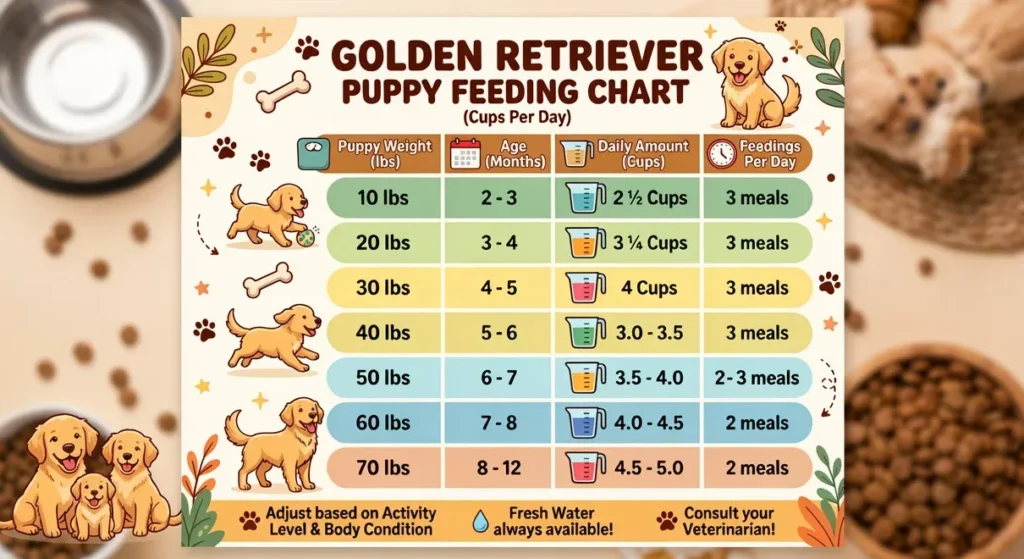
A rough starting point: an 8-week-old golden around 10–15 lbs needs roughly 1.5–2 cups of large-breed puppy food daily, split across four meals.
By 4 months, that climbs to around 2.5–3 cups across three meals.
Growth slows between 12 and 18 months, and that’s when most owners can safely move to two meals a day.
Quick Note: These are starting points, not gospel. Every golden’s metabolism is a little different, and the only reliable adjustment tool is the rib check — you should feel ribs easily under a thin layer of fat without seeing them.
The Calcium-Phosphorus Ratio Nobody Explains Properly
Here’s what most guides skip entirely. A bag of puppy food can say “complete and balanced“ and still be wrong for a large breed if the calcium-to-phosphorus ratio isn’t dialed in.
For golden retriever puppies, look for a ratio close to 1:1 up to about 1.3:1, with total calcium staying under roughly 1.8% on a dry matter basis.
This single number — buried in fine print on the guaranteed analysis panel — has more to do with your dog’s future hip X-rays than almost anything else on the label.

Some breeders argue that homemade or raw diets give better control over this ratio.
That’s valid if you’re working with a board-certified veterinary nutritionist who can formulate the recipe precisely.
But for most first-time owners, an AAFCO-compliant large-breed commercial formula is safer because the calcium math is already done for you.
Transitioning Between Life-Stage Foods
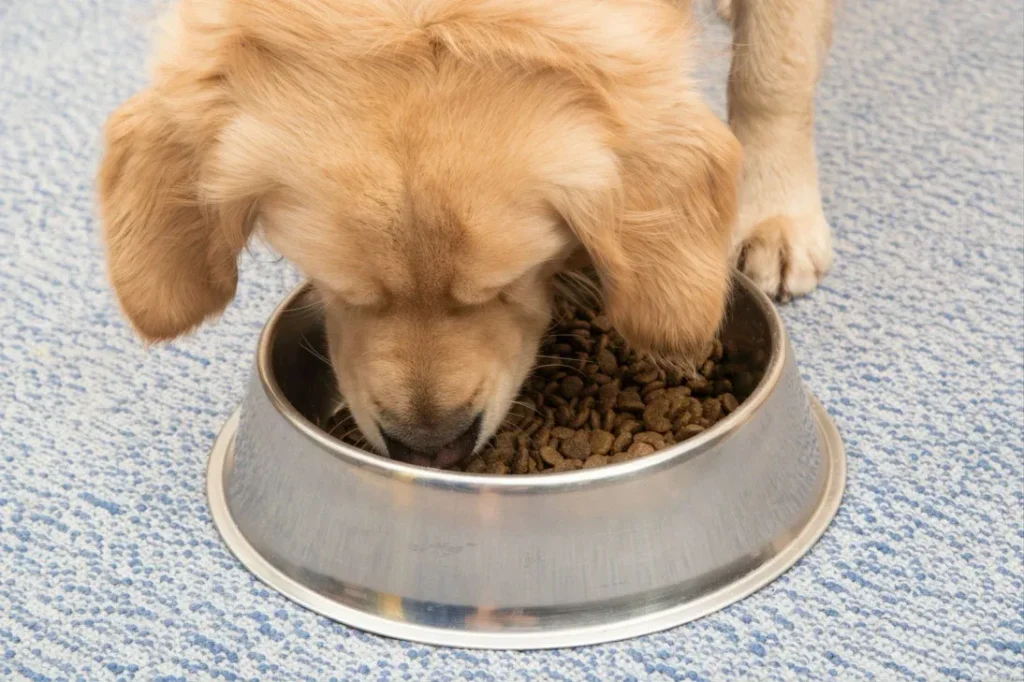
Most articles tell you to switch foods “around 12-18 months” and stop there.
What they don’t cover is the actual transition — and getting it wrong causes the diarrhea and food refusal that send owners straight back to Google.
Mix new food in gradually over 7–10 days: 25% new food for two days, 50% for three days, 75% for two days, then fully switched.
Doing it faster than that is the single most common reason golden retriever puppies get an upset stomach during a food change.
I’ve seen conflicting guidance on exact transition length — some vets say 5 days is fine, others insist on 10–14 for sensitive stomachs.
My Read: Golden retrievers tend to have sensitive digestion as a breed, so erring toward the longer 10-day window is the safer default.
Common Feeding Mistakes With Golden Retriever Puppies

- Free-feeding (leaving food out all day) instead of scheduled meals, which removes any ability to control growth rate.
- Adding calcium or vitamin supplements “just in case” — this is one of the fastest ways to push a puppy’s calcium intake into dangerous territory.
- Switching brands repeatedly when a puppy has loose stool, instead of checking portion size and treat intake first.
This guide covers commercial large-breed puppy diets and the nutritional principles behind them.
It does not cover prescription diets for puppies with diagnosed medical conditions — that’s a conversation for your veterinarian, not an article.
FAQ’s
What’s the best food for a golden retriever puppy?
A large-breed-specific puppy formula with controlled calcium (around 1.1–1.8% DM) and a 1:1 to 1.3:1 calcium-to-phosphorus ratio, like Purina Pro Plan or Royal Canin large-breed puppy lines.
How do I know if I’m feeding my golden retriever puppy too much?
Check the rib test weekly — if you can’t feel ribs easily under a thin fat layer, reduce portions by about 10% and recheck in two weeks.
Should I feed my golden retriever puppy raw or kibble?
Kibble formulated for large-breed puppies is safer for most owners since the calcium ratio is pre-balanced; raw diets require a veterinary nutritionist to avoid imbalances.
Why does my golden retriever puppy need large-breed food specifically?
Standard puppy food grows bones faster than cartilage can support in heavy breeds, raising hip and elbow dysplasia risk; large-breed formulas slow that growth rate intentionally.
When should I switch my golden retriever from puppy to adult food?
Around 12–18 months, once growth has visibly slowed, transition gradually over 7–10 days to avoid digestive upset.
Conclusion
Feeding a golden retriever puppy right isn’t about finding one perfect brand — it’s about understanding the principles behind the label.
Large-breed formula, controlled calcium, gradual transitions, and a rib check instead of a guessing game.
Get those four things right, and you’ve covered most of what actually affects your puppy’s joints down the line.
Quick Note: If your puppy has a diagnosed condition or a sensitive stomach beyond normal food-switch upset, none of this replaces a vet visit. This guide covers healthy puppies eating commercial large-breed diets — not prescription nutrition.
Start with the feeding chart on your current bag, run the rib check in two weeks, and adjust from there. That’s really it.


